
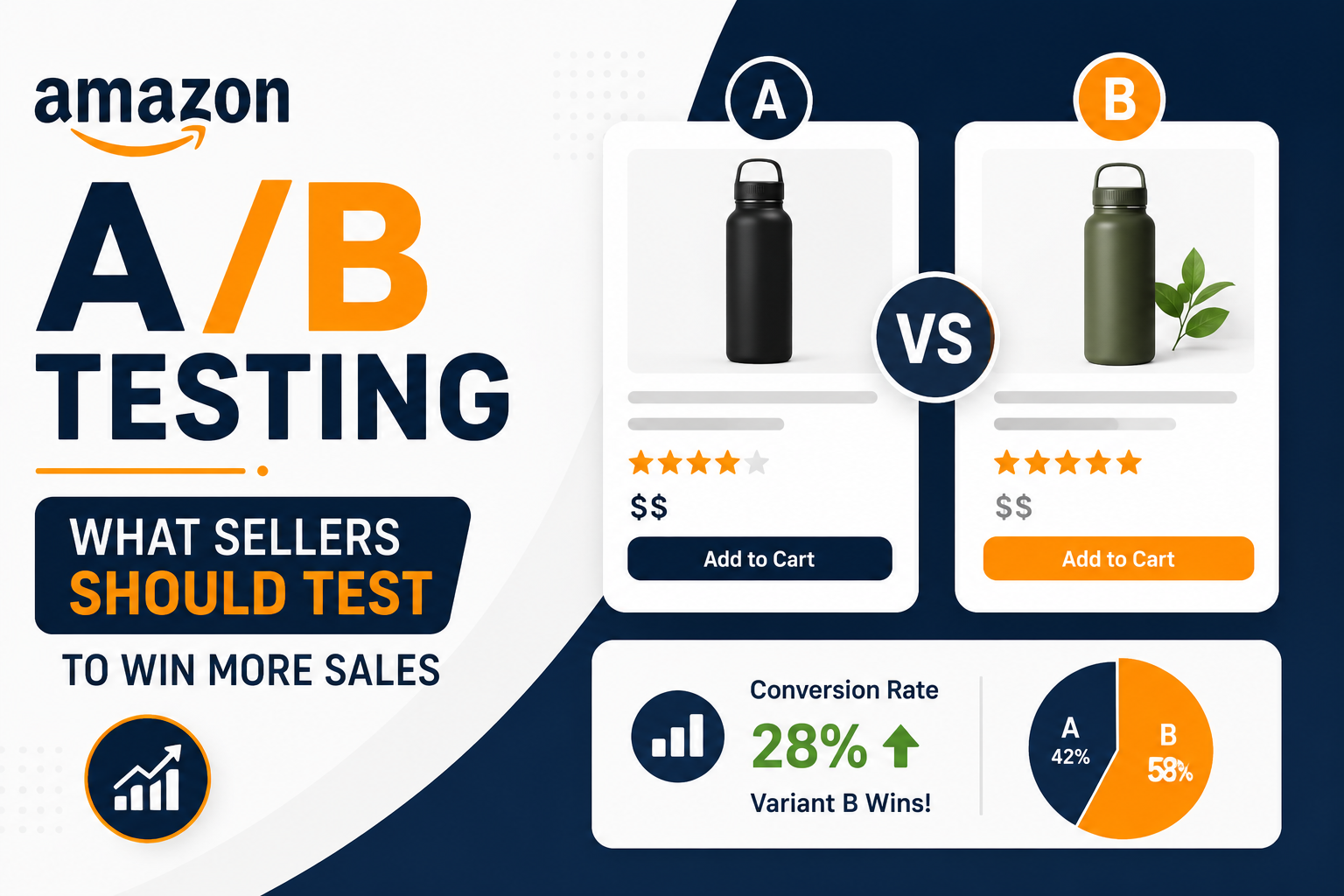
Most Amazon sellers guess what works. Then they wonder why sales stay flat.
A/B testing removes the guesswork. It shows you what your buyers actually respond to, not what you assume they like.
For sellers in Australia, this matters even more. The market is smaller than the US, competition per category is tighter, and every click counts. You cannot afford to run ads toward a listing that quietly underperforms.
This guide walks through exactly what to test, how to test it properly on Amazon, and which changes tend to move the needle for Australian sellers in 2026.
What Is Amazon A/B Testing, Really
Amazon A/B testing, officially called Manage Your Experiments, lets sellers compare two versions of a listing element. One version runs for a set period. Then Amazon shows you which version performed better.
It is not a guess. It is a controlled experiment, similar to how you would test a landing page or an email subject line.
The tool sits inside Seller Central, under the Brand Analytics section. Brand registered sellers get access. This is one more reason brand registration is worth completing early, especially for sellers building out their presence on Amazon Australia.
You pick an element to test, such as your main image. Amazon splits traffic between the two versions. After two to eight weeks, depending on your traffic volume, Amazon declares a statistically significant winner.
Why Australian Sellers Cannot Skip This Step
Amazon.com.au is younger and smaller than Amazon.com. Traffic per keyword is lower. That means every visitor matters more.
A one percent lift in conversion rate on a US listing might feel small. On an Australian listing with fewer daily visits, that same lift can be the difference between profitability and losing money on ads.
Local buying behaviour also differs. Australian shoppers tend to check reviews carefully before buying. They respond well to authenticity over hype. Testing helps you find the tone and proof points that actually convince this audience, rather than copying what worked overseas.
Freight costs, GST inclusion, and delivery timelines shown on listings also shape decisions here. Small wording changes around shipping can shift conversion more than sellers expect.
What Should Sellers Test First
Not every element deserves equal attention. Some changes move sales more than others. Here is where to start.
1. Main Product Image
The main image is the first thing a shopper sees in search results. It decides whether someone clicks at all.
Test variations such as:
- Product on a plain white background versus a lifestyle shot
- Different angles showing scale or use
- Packaging visible versus product only
A clearer, more literal image often outperforms a creative one. Shoppers want to know exactly what they are buying before they click.
2. Title Structure
Titles affect both search ranking and click through rate. Amazon rewards relevant keywords, but readability still matters to the human reading it.
Try testing:
- Keyword order, with the primary keyword placed early
- Shorter titles versus longer, feature packed ones
- Brand name placement at the start versus after the product description
For sellers targeting Australian search intent, phrases like “buy online Australia” or “fast delivery Australia” sometimes work into secondary listing fields, though titles should stay focused on product clarity first.
3. Secondary Images and Infographics
After the main image, secondary images do the convincing. This is where you answer objections before the shopper types them into a review search.
Test:
- Infographic heavy images versus lifestyle photography
- Size charts and comparison charts versus pure product beauty shots
- Text overlay density, since some buyers want quick facts, others want a cleaner look
4. Product Title and Bullet Point Combinations
Bullet points carry a lot of weight for considered purchases, like electronics or health products.
Compare:
- Benefit led bullets versus feature led bullets
- Short punchy bullets versus detailed, spec heavy ones
- Bullets that address common questions directly
5. A+ Content Layouts
A+ Content, also called Enhanced Brand Content, is available to brand registered sellers. It replaces plain text descriptions with modules, comparison charts, and brand storytelling.
Test:
- Comparison chart modules versus lifestyle story modules
- Video inclusion versus static image modules
- Short form content versus long form, detail heavy layouts
Sellers who invest properly in this area, through structured <a href=”https://qiicreative.com.au/services/amazon-store-management/”>Amazon store management</a>, often see more consistent uplift here than from any single image swap, simply because A+ Content touches multiple decision points at once.
6. Pricing and Coupons
Price itself is harder to A/B test cleanly through Amazon’s tool, since pricing changes affect Buy Box eligibility. But sellers can test:
- Coupon badges versus no visible discount
- Bundle pricing versus single unit pricing
- Subscribe and Save framing versus one time purchase framing
A Simple A/B Testing Checklist
Use this order when planning your first few tests.
- Confirm brand registry access in Seller Central.
- Pick one variable only. Do not change image and title together.
- Set a realistic test duration, usually four weeks minimum for moderate traffic listings.
- Wait for statistical significance before declaring a winner.
- Apply the winning version permanently.
- Move to the next variable and repeat.
Testing one variable at a time is not optional. Changing two things together makes it impossible to know which change caused the result.
How Long Should a Test Run
| Daily Sessions | Suggested Test Duration |
|---|---|
| Under 100 sessions/day | 6 to 8 weeks |
| 100 to 500 sessions/day | 3 to 4 weeks |
| Over 500 sessions/day | 2 to 3 weeks |
Lower traffic listings, which are common in the Australian marketplace compared to the US, need longer test windows to reach reliable results. Ending a test early is one of the most common mistakes sellers make.
Common Mistakes Sellers Make With A/B Testing
- Stopping a test too early because one version looks ahead after a few days
- Testing during a promotional period, which skews results
- Testing too many variables at once
- Ignoring mobile preview, since most Australian shoppers browse on mobile
- Not documenting results, so the same failed idea gets tested again months later
Tips for Getting Reliable Results
- Run tests during a normal sales period, not during Black Friday or Prime Day.
- Keep your ad spend consistent during the test so traffic volume does not skew data.
- Screenshot both variations before starting, since Amazon’s interface does not always retain old versions clearly.
- Review results by device type where possible. Mobile and desktop shoppers do not always respond the same way.
- Combine A/B test data with your Search Query Performance report for a fuller picture of buyer intent.
Frequently Asked Questions
Does every seller have access to Amazon A/B testing? No. Manage Your Experiments is available to brand registered sellers only. Sellers without brand registry cannot run structured tests through this tool.
How long does an Amazon A/B test need to run? Most tests need at least two to eight weeks, depending on traffic volume. Lower traffic listings need longer periods to reach statistical significance.
Can sellers test price directly through Amazon? Not cleanly. Price changes affect Buy Box eligibility and ranking in ways that complicate clean testing. Sellers usually test coupons or bundle framing instead.
What is the single most impactful test for a new listing? Main image testing typically has the biggest early impact, since it directly affects click through rate from search results.
Should Australian sellers copy strategies from US listings? Not directly. Buying behaviour, delivery expectations, and price sensitivity differ. Testing locally gives more reliable answers than assuming US results will transfer.
Final Thoughts
A/B testing is not a one time project. It is an ongoing habit that separates sellers who guess from sellers who grow steadily.
Small, consistent tests, run properly and one variable at a time, compound over months into meaningfully better conversion rates. For sellers competing in the Australian marketplace, where every visitor counts more, this discipline pays off faster than most other optimisation work.
If you want help setting up a structured testing plan for your Amazon Australia listings, our team can walk you through it. Get in touch with us here to discuss your current listings and where testing could help most.