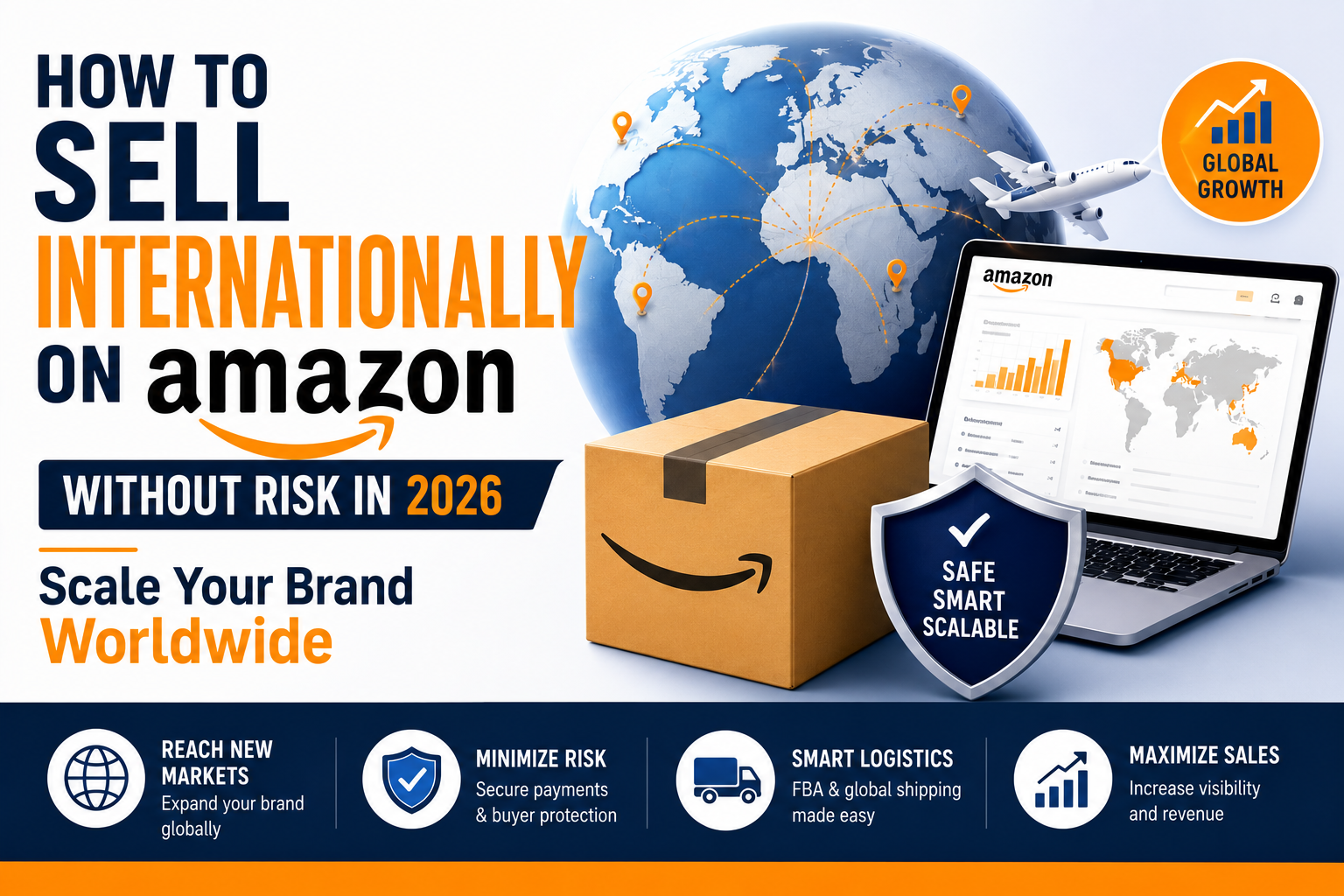
So you have got a product doing well on Amazon Australia. Sales are steady. Reviews are decent. And now you are wondering if it is time to go global.
Here is the honest answer. Selling internationally on Amazon in 2026 is more accessible than ever, but it is not something you should rush into blind. The sellers who scale safely are the ones who understand the risks before they list a single product overseas.
This guide walks you through exactly how Australian sellers can expand into international Amazon marketplaces without losing money, stock, or their seller account along the way.
Why Australian Sellers Are Looking Beyond the Local Market
Amazon Australia has grown fast. Local online store revenue hit 1.57 billion dollars in 2023, up from 1.29 billion the year before, and analysts expect the marketplace to track toward roughly 10 billion dollars in total estimated sales by 2026.
That growth is good news. But it also means more competition for the same shoppers. Many Australian sellers who have already built a solid catalogue are now asking a simple question. Why limit myself to one country when the same listing could sell in the UK, the US, or across Europe?
Globally, third party sellers already control 61 percent of units sold on Amazon, and third party sellers generated around 575 billion dollars in global gross merchandise value in 2025 alone. That is a massive pool of demand most single market sellers never tap into.
Interestingly, around 69 percent of Amazon sellers still operate in only one marketplace. That hesitation creates real opportunity for Australian brands willing to expand properly.
The Real Risks of Selling Internationally on Amazon
Before we talk strategy, let us be upfront about what can go wrong. This is the part most guides skip, and it is exactly why so many international expansions fail.
- Tax and compliance gaps. Every country has its own VAT, GST, or sales tax rules. Miss a registration deadline and you could face fines or a frozen account.
- Account suspensions. Amazon links accounts across regions in some cases. A policy issue in one marketplace can affect your global selling privileges.
- Currency and payout delays. Getting paid in AUD from a US or UK sale is not automatic. You need the right banking setup from day one.
- Shipping and customs surprises. Cross border logistics come with duties, customs declarations, and longer delivery windows if not planned well.
- Brand protection gaps. Without trademark registration in the destination country, counterfeit listings can appear on your product pages within weeks.
None of these risks should stop you from expanding. They just mean you need a plan, not a guess.
How to Sell Internationally on Amazon Without Risk in 2026: Step by Step
Here is the framework that actually works for Australian sellers moving into new Amazon marketplaces this year.
Step 1: Pick the Right Marketplace First
Do not try to launch in five countries at once. Amazon now operates 22 global stores, and each one has different demand, competition, and regulatory requirements.
For most Australian brands, the smartest first moves are usually the UK, the US, or Singapore, since English language listings transfer with minimal rework. The UK and EU marketplaces remain less saturated than the US in many private label categories, especially for brands willing to localise their listings rather than simply copy them across.
Ask yourself:
- Does my product already sell well in Australia in a category with global demand?
- Is there existing search volume for my product type in the target country?
- Can I meet that country’s safety, labelling, and packaging standards?
Step 2: Sort Out Tax and Legal Requirements Early
This is the step most sellers underestimate, and it is where risk actually lives.
Value added tax applies in most countries outside North America. You must register once your turnover crosses that country’s threshold, then collect and remit tax on every sale. Amazon’s tax calculation service can handle much of this automatically, but the legal responsibility still sits with you as the seller.
Practical checklist:
- Register for GST, VAT, or sales tax in each target country once thresholds are met.
- Keep separate records for each marketplace’s tax obligations.
- Speak with an accountant familiar with cross border ecommerce before your first international listing goes live.
- Confirm your business structure supports overseas trading (most Australian companies can, but check with your advisor).
Step 3: Use Amazon’s Global Selling Tools Properly
Amazon’s Build International Listings tool lets you cross list products from your existing account into new marketplaces without creating everything from scratch. It syncs pricing, inventory, and even applies currency conversion automatically.
This single tool removes a huge chunk of manual work and reduces listing errors, which are one of the most common causes of account flags during international expansion.
Step 4: Protect Your Brand Before You Expand
Enrol in Amazon Brand Registry for each marketplace you plan to sell in. This protects your listings from hijacking and gives you access to A+ Content, Sponsored Brands ads, and stronger reporting tools.
If you are managing multiple storefronts across regions, having a dedicated team handle listing consistency, compliance checks, and account health monitoring makes a real difference. Many growing brands work with an experienced Amazon store management service to keep every marketplace running smoothly without hiring an entire in house team.
Step 5: Choose the Right Fulfilment Model
You have three real options for international orders.
| Fulfilment Option | Best For | Key Consideration |
|---|---|---|
| Amazon FBA (local) | Sellers wanting Prime eligibility fast | Requires stock stored in destination country |
| Amazon FBA export | Testing new markets with existing stock | Slower delivery, limited product eligibility |
| Third party logistics (3PL) | Sellers scaling across multiple regions | More control, but requires vetting a reliable partner |
Globally, 78 percent of sellers prefer FBA for the Prime badge and convenience, while 34 percent use FBM for tighter cost control, and 22 percent run both models depending on the product. FBA sellers also report noticeably stronger first year earnings compared to FBM only sellers.
Scaling Your Brand Worldwide Without Losing Control
Once your first international marketplace is stable, scaling becomes about systems, not guesswork.
Standardise your listing process. Use the same optimised structure for titles, bullet points, and images across every marketplace, adjusted only for local language and measurement units.
Watch your ACOS by region. Advertising costs vary widely by marketplace. Sellers typically spend 20 to 25 percent of revenue on ads for new launches, tightening toward 10 to 15 percent once reviews and rankings stabilise.
Automate what you can. Repricing, inventory alerts, and review requests should not require manual checking across five different dashboards every day.
Localise, do not just translate. A listing that simply translates Australian copy word for word rarely converts as well as one written for local buyer language and search habits.
Key Amazon Global Selling Statistics for 2026
| Metric | Figure |
|---|---|
| Amazon total revenue, 2025 | 638.0 billion dollars |
| Third party unit share globally | 61 percent |
| Third party global GMV, 2025 | Around 575 billion dollars |
| Sellers operating in only one marketplace | 69 percent |
| Sellers preferring FBA | 78 percent |
| Amazon global stores in operation | 22 marketplaces |
| Sellers reaching profitability within 12 months | 58 percent |
These numbers tell a clear story. The opportunity is large, competition is real, but most sellers are still not expanding. That gap is where Australian brands can move in.
Common Mistakes Australian Sellers Make Going International
- Launching in too many marketplaces at once instead of proving one first.
- Ignoring local tax registration until Amazon flags the account.
- Copying Australian pricing directly without adjusting for local shipping and duty costs.
- Skipping trademark registration in the new country.
- Underestimating how long customer support needs to cover different time zones.
Tips and Tricks for a Risk Free Global Expansion
- Start with one new marketplace and give it 90 days before adding another.
- Keep a small buffer of working capital for unexpected duties or return shipping.
- Set up a multi currency bank account before your first international sale, not after.
- Monitor account health daily during your first month in a new marketplace.
- Ask your logistics partner for a written breakdown of all landed costs before committing stock.
Frequently Asked Questions
Is it risky for Australian sellers to expand into Amazon UK or US in 2026?
There is always some risk, mainly around tax compliance and logistics. That risk drops significantly when you register correctly, use Amazon’s official tools, and start with one marketplace at a time.
Do I need a separate Amazon seller account for each country?
Not always. Amazon groups certain regions under one unified account, particularly across Europe, while others like the US and Australia require separate registrations. Check current requirements before assuming either way.
How much capital do I need to start selling internationally?
This depends heavily on your category and fulfilment model. Many sellers start small by testing one product line through FBA export before committing to full local inventory.
Can I use my existing Australian listings for other marketplaces?
Yes, through Amazon’s Build International Listings tool, though you should still review and localise content rather than copying it directly.
What is the biggest reason international expansions fail?
Poor preparation around tax compliance and cash flow, more often than product demand itself.
Final Thoughts
Selling internationally on Amazon in 2026 is not about rushing into every marketplace at once. It is about picking the right one, protecting your brand, and building systems that scale without constant firefighting.
Australian sellers who take this approach are already seeing steady growth across UK, US, and Singapore marketplaces while competitors stay stuck in one region.
If you want a clearer picture of how this could work for your specific brand, get in touch with our team and we can walk through what a safe international rollout looks like for your products.