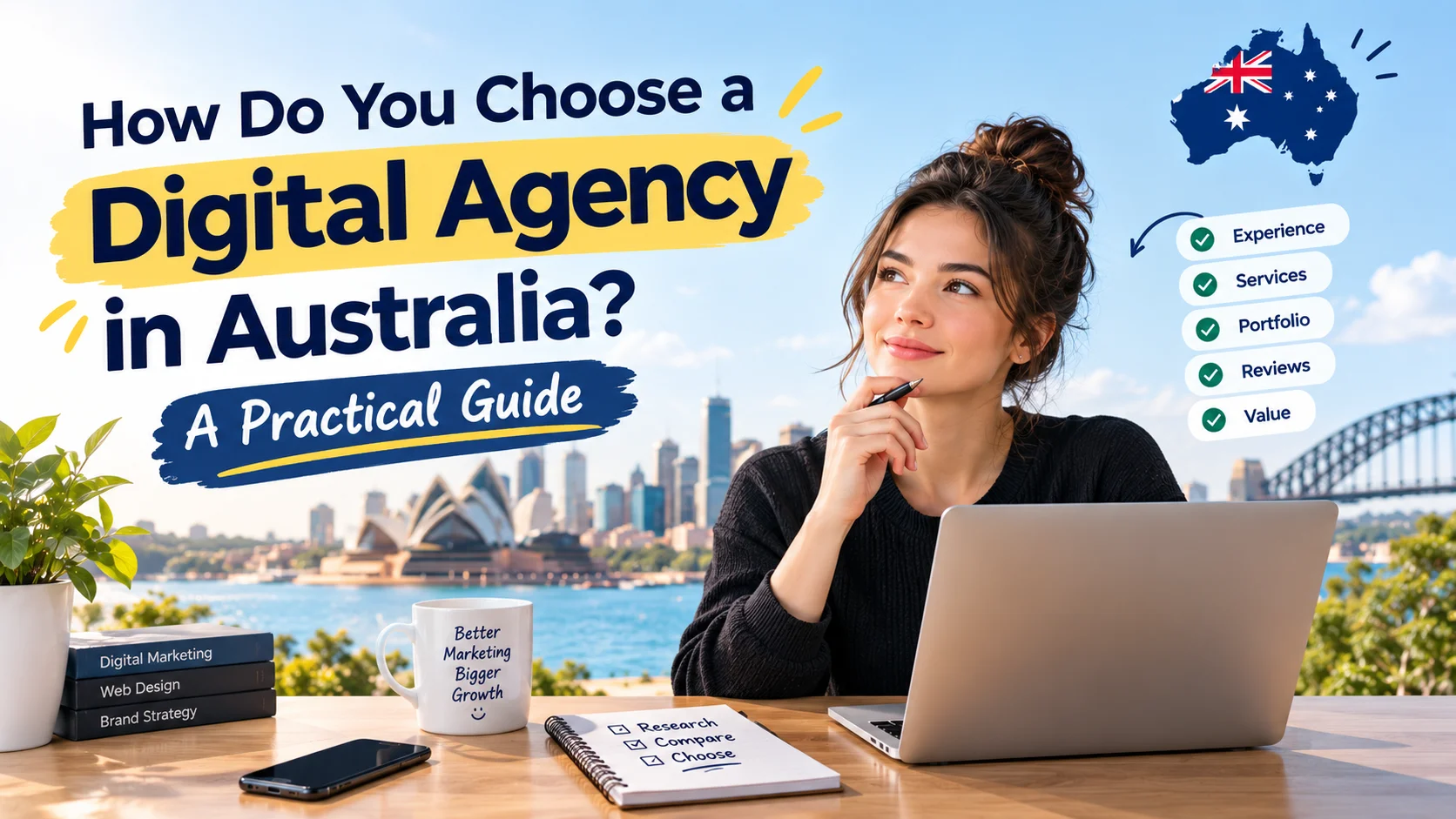
The best way to choose a digital agency in Australia is to match its skills to your business goals, then check the proof. Review relevant case studies, ask how success will be measured, and make sure the agency explains its plan in plain English.
A poor fit costs more than money. You can lose months of momentum and search visibility. A good agency works like an extension of your team.
This guide covers what agencies do, what to check, how to compare them, which red flags to avoid and what to ask before you sign.
What Does a Digital Agency Actually Do?
A digital agency helps businesses attract, convert and keep customers online. Most combine strategy, design and marketing under one roof.
Common services include:
- Web design and development: building fast, easy-to-use websites
- SEO (search engine optimisation): helping your site appear in search results and AI answers
- Digital marketing: planning and running campaigns across channels
- Content marketing: articles, guides and videos that answer customer questions
- Paid advertising: Google Ads and social media campaigns
- Branding and creative services: logos, messaging and visual identity
- Conversion optimisation: turning more visitors into enquiries or sales
- Digital strategy: deciding what to do first, and why
Some firms are full-service. Others are a creative agency in Australia that leans towards branding and design. Others are a digital marketing specialist focused on search and ads. None is better by default. It depends on what you need.
What Should You Look for When Choosing a Digital Agency in Australia?
Check ten things: relevant experience, proven results, service fit, SEO skill, website quality, communication, strategy, pricing, transparency and local market knowledge. Here is what each means in practice.
1. Relevant Industry Experience
Experience with similar businesses shortens the learning curve. An agency that has worked with trades businesses understands local search. One that has worked in B2B understands long sales cycles.
Ask what they have learned from your sector, not just whether they have worked in it.
2. Proven Results and Case Studies
Client logos prove very little. A good case study shows the problem, the approach and the outcome.
Look for measurable results such as enquiries, organic traffic, conversion rate or cost per lead. Reading through digital marketing case studies shows how an agency handles real business challenges. Then ask whether a past client would be happy to talk to you.
3. The Right Services for Your Goals
The longest service list is not the best one. If you need more leads from search, you need SEO and a strong website, not a brand overhaul.
Start with your goal. Then choose the agency whose strengths line up with it.
4. SEO and Technical Capability
A capable SEO agency should understand:
- Keyword research and search intent
- Site structure, speed and mobile usability
- On-page optimisation and content planning
- Local SEO and Google Business Profile
- Tracking through Google Analytics and Search Console
Ask them to explain their approach to SEO strategy in simple terms. If the answer is all jargon, be cautious.
5. Website Design and User Experience
Your website is often the first impression. Poor design hurts credibility and conversions. Good UX/UI makes it easy for people to find information, trust you and get in touch.
Check that the agency builds for speed, accessibility and mobile. A team with real web design and development experience should explain design choices through user behaviour, not personal taste.
6. Communication and Reporting
Good communication means a named contact, agreed response times and regular reports. Reports should explain what changed, why it changed and what happens next. Screenshots of charts are not enough.
7. Strategy Instead of Random Tactics
Tactics are tasks, like a blog post, an ad or a new banner. Strategy is the reason behind them.
A good agency starts with your audience, competitors and goals, then builds a roadmap. If they jump straight to a fixed package, you may be buying a template.
8. Pricing and Value
The cheapest quote often has the vaguest scope. Compare what is included: hours, deliverables, reporting, tools and support. Ask what is not included.
Value means the work moves your goals forward. It does not mean the lowest monthly fee.
9. Transparency
A transparent agency tells you what they will do, who will do it and what it costs. They explain timelines, risks and what is outside their control.
You should also own your website, domain, ad accounts and analytics.
10. Understanding of the Australian Market
Australian buyers, regulations and competition differ from overseas markets. Local knowledge includes Australian English, privacy rules, regional search behaviour and how local customers research and buy.
This leads to better copy, better targeting and fewer costly mistakes.
How Do You Compare Digital Agencies Side by Side?
Use the same checklist for every agency on your shortlist. Score each one from 1 to 5.
| Factor | What to Check |
|---|---|
| Experience | Relevant industry and project experience |
| Services | Whether services match your goals |
| Case studies | Evidence of measurable outcomes |
| SEO capability | Technical and strategic SEO knowledge |
| Communication | Reporting and response process |
| Strategy | A clear plan rather than random tactics |
| Pricing | Clear scope and realistic value |
| Support | Ongoing support and accountability |
Shortlist three agencies and ask each the same questions. Compare the answers, not the sales pitches.
Searches like “best digital agency in Australia” or “top digital agencies in Australia” return lists, but no list knows your business. Use them as a starting point only. The best digital marketing agency Australia has for you is the one that fits your goals, budget and industry.
Red Flags to Watch for When Choosing a Digital Agency
- Guaranteed rankings. No one controls Google. Honest agencies talk about effort and likelihood, not promises.
- Unrealistic promises. SEO usually takes months. Instant results should make you suspicious.
- No clear strategy. Without a plan, you cannot tell if the work is helping.
- No measurable reporting. If results are not tracked, they cannot be proven.
- Poor communication before you sign. It rarely improves afterwards.
- Hidden fees. Ad spend, software and extra revisions should be explained upfront.
- Vague deliverables. “Ongoing optimisation” means little without specifics.
- Copy-paste strategies. Your competitors and customers are different from everyone else’s.
- No relevant case studies. You have no evidence they can do the job.
- Vanity metrics. Likes and impressions do not pay bills. Leads and sales do.
- Very cheap offers with unclear scope. Low prices often mean limited work.
What Should You Ask a Digital Agency Before Hiring Them?
Ask these questions in your first meeting:
- What experience do you have with businesses like mine?
- Can you show relevant case studies?
- What would your first 90 days look like?
- How will you measure success?
- Who will manage my account, and who does the work?
- How often will I receive reports?
- What is included in the monthly fee?
- What happens if my priorities change?
- How do you approach SEO?
- How do you improve website conversions?
- Will I own my website, accounts and data?
- What do you need from me to get good results?
- What is the minimum contract length, and how do I exit?
Listen for specific, honest answers. “It depends” is fine when it is followed by a clear explanation.
What Should You Expect from Digital Agency Services in Australia?
You should expect a clear plan, honest reporting and work that links to business outcomes. You should not expect every service.
The right mix of digital agency services in Australia depends on:
- Your business goals
- Your target audience
- Your industry and competition
- Your existing website
- Your budget
- Your growth stage
- Your sales process
A new business may need a website and local SEO first. An established one may need conversion optimisation and paid advertising. A good agency recommends what you need, even if that is less than you expected.
How Should Darwin and Northern Australian Businesses Choose?
Businesses in Darwin and the Top End face a smaller local market, seasonal swings and strong tourism, government and trades sectors. That makes local knowledge useful.
When assessing a digital agency in Darwin, ask whether they understand your regional audience and can support you in person when needed. Equally, a strong remote agency can work well if its communication is solid.
If you are comparing a digital marketing agency in Darwin with a larger southern firm, judge both by the same standards: proof, strategy and transparency. Location helps, but it does not replace capability.
Frequently Asked Questions
How much does a digital agency cost in Australia?
Costs vary widely based on scope, agency size and the work involved. A website build, a monthly SEO retainer and a paid ads campaign are priced very differently. Ask for a written scope and compare what is included, not just the total.
What services should a digital agency provide?
That depends on your goals. Most agencies cover web design, SEO, content, paid advertising and strategy. Some add branding and creative work. Choose services that match your needs rather than the longest list.
How do I know if a digital agency is good?
A good agency shows relevant case studies, explains its strategy clearly and reports honestly on results. It also asks questions about your business before proposing solutions. Speaking with a past client is the best check.
Should I choose a local digital agency?
A local agency can offer face-to-face meetings and regional insight, which helps in places like Darwin. But location is only one factor. A remote agency with strong results and clear communication can be just as effective.
How long does it take to see results from a digital agency?
Paid advertising can bring traffic within days. SEO and content usually take several months to build momentum. A good agency sets realistic timelines and explains what you should see at each stage.
Should I choose an agency that offers everything?
Not necessarily. Full-service agencies are convenient, but specialists can go deeper in one area. Pick based on your main goal and how much coordination you want to manage yourself.
Meta Title: How to Choose a Digital Agency in Australia (Checklist)
Meta Description: Not sure how to choose a digital agency in Australia? Learn what to check, which questions to ask, and the red flags to avoid before you hire a partner.
I can also put this into a Word doc or Markdown file if you’d like.
avoid this topic write anothjer different topic blog same country and website
How Much Does a Website Cost in Australia? What Affects the Price
A website in Australia can cost anywhere from a few thousand dollars for a simple site to much more for a custom build with advanced features. The final price depends on size, design, functionality, content and who builds it. Always ask for a written scope before comparing quotes.
This guide avoids made-up price tables. Quotes vary too much between agencies, industries and projects. Instead, it explains what drives the cost, what to expect in a quote and how to spot good value.
What Actually Determines the Cost of a Website?
Website cost is driven by the amount of work involved. More pages, more custom design and more features all mean more hours.
The main factors are:
- Number of pages: a five-page site takes less time than a 50-page one
- Design approach: a template is cheaper than a fully custom design
- Functionality: bookings, online payments, member logins and quote calculators add complexity
- Content: copywriting, photography and video take time and skill
- Integrations: CRM, email marketing and accounting tools need setup and testing
- SEO groundwork: structure, speed and technical setup built in from the start
- Who builds it: a freelancer, a small studio and a large agency price differently
What Are the Main Types of Websites?
Most business websites fall into four groups. Knowing which one you need helps you judge quotes.
Brochure or Service Websites
These present your business, services and contact details. They suit trades, consultants, clinics and local service providers.
They are the simplest and usually the most affordable option. They still need good design, clear messaging and fast loading.
Lead Generation Websites
These are built to produce enquiries. They have stronger messaging, clear calls to action, landing pages and tracking.
Many Australian small and medium businesses need this type. The goal is not just to look good. It is to bring in customers.
eCommerce Websites
These sell products online. They need product pages, payments, shipping rules, tax settings and inventory tools.
Costs rise with the number of products and the complexity of the checkout.
Custom Web Applications
These are bespoke platforms, portals or tools. They need planning, development and testing, so they take the most time and budget.
What Should Be Included in a Website Quote?
A good quote lists exactly what you are paying for. If it only says “website design”, ask for more detail.
Look for:
- Number of pages and templates
- Design rounds and revisions
- Mobile responsiveness
- Content creation or content loading
- Basic SEO setup
- Speed and security setup
- Training on how to edit your site
- Testing before launch
- Support after launch
- Ownership of the site, domain and files
An agency with real web design and development experience should be able to explain each of these without jargon.
What Costs Do People Forget About?
The build price is not the full cost. Several ongoing items often get missed.
- Domain name: renewed yearly
- Hosting: monthly or yearly, and quality varies
- Software licences: some plugins and themes need paid renewals
- Security and updates: sites need regular maintenance
- Content updates: new pages, offers and blog posts
- Marketing: a new website does not bring visitors on its own
That last point matters most. Many businesses launch a site and wait for enquiries that never arrive. Visibility takes ongoing effort, such as SEO, content and sometimes paid advertising.
Is a Cheap Website Worth It?
Sometimes, but be careful. A low price can be fine for a simple site with limited needs. It becomes a problem when the scope is unclear or the work is rushed.
Common trade-offs with very cheap offers include:
- Generic templates that look like everyone else’s
- Slow loading speeds
- Poor mobile layout
- No SEO foundation
- Limited support after launch
- Unclear ownership of your site
Fixing a poor website later can cost more than building it properly the first time.
Template vs Custom Website: Which Should You Choose?
A template suits a simple site on a tight budget. A custom design suits businesses that need a unique look, special features or stronger conversion performance.
| Factor | Template Website | Custom Website |
|---|---|---|
| Cost | Usually lower | Usually higher |
| Speed to launch | Faster | Slower |
| Uniqueness | Limited | Fully tailored |
| Flexibility | Restricted by the template | High |
| Best for | Simple sites, startups | Growing or complex businesses |
Neither is always better. Choose based on your goals, not on what sounds more impressive.
How Do You Get Good Value From Your Website Budget?
Spend where it affects results. Value comes from a site that earns its keep, not from the lowest price.
Here are practical ways to get more from your budget:
- Know your goal first. Do you want calls, bookings or online sales?
- Prepare your content. Clear photos and text save time and cost.
- Start with what matters. You can add features later.
- Plan for growth. Choose a platform that can expand with you.
- Check proof. Reviewing past digital marketing case studies shows how an agency turns a brief into measurable outcomes.
What Should You Ask Before Agreeing to a Quote?
Ask these questions before you sign:
- What exactly is included in the price?
- How many design revisions do I get?
- Who owns the website and the files?
- Will the site be built for mobile and speed?
- Is basic SEO included?
- What are the ongoing hosting and maintenance costs?
- How long will the project take?
- What do you need from me, and by when?
- What support do I get after launch?
- How do you measure whether the site is working?
Clear answers suggest a professional process. Vague answers suggest risk.
Red Flags in Website Pricing
Watch out for:
- Quotes with no breakdown. You cannot compare what you cannot see.
- Pressure to sign quickly. Good agencies give you time to decide.
- Promises of top Google rankings. No one can guarantee them.
- Locked-in ownership. You should own your domain and content.
- No mention of ongoing costs. Surprises later cause frustration.
- No examples of past work. You need evidence of quality.
How Long Does It Take to Build a Website?
Simple sites can take a few weeks. Larger or custom projects can take several months. Delays often come from late content or slow feedback, not just design work.
Ask for a timeline in writing. Agree on who is responsible for each step.
Frequently Asked Questions
How much should a small business spend on a website in Australia?
It depends on what the site needs to achieve. A simple service website costs far less than an online store or a custom platform. Focus on the scope, the quality of the work and how well the site supports your goals.
Are cheap websites bad?
Not always. A low-cost site can work for simple needs. The risk is unclear scope, weak design or poor support. Check what is included before deciding.
Do I need to pay for hosting separately?
Often yes. Some agencies include hosting in a monthly plan. Others expect you to arrange it. Ask how hosting, security and updates are handled.
Is SEO included in a website build?
Basic SEO setup, such as page structure and speed, is often part of a good build. Ongoing SEO, such as content and link building, is usually separate. Confirm this in writing.
Should I use a freelancer or an agency?
A freelancer can suit small, simple projects. An agency offers a wider team, covering design, development, strategy and marketing. Choose based on the size of your project and the level of support you need.
How can I tell if a website quote is fair?
Collect two or three quotes with the same brief. Compare scope, deliverables, timelines and support. A fair quote explains what you get and why it costs what it does.