
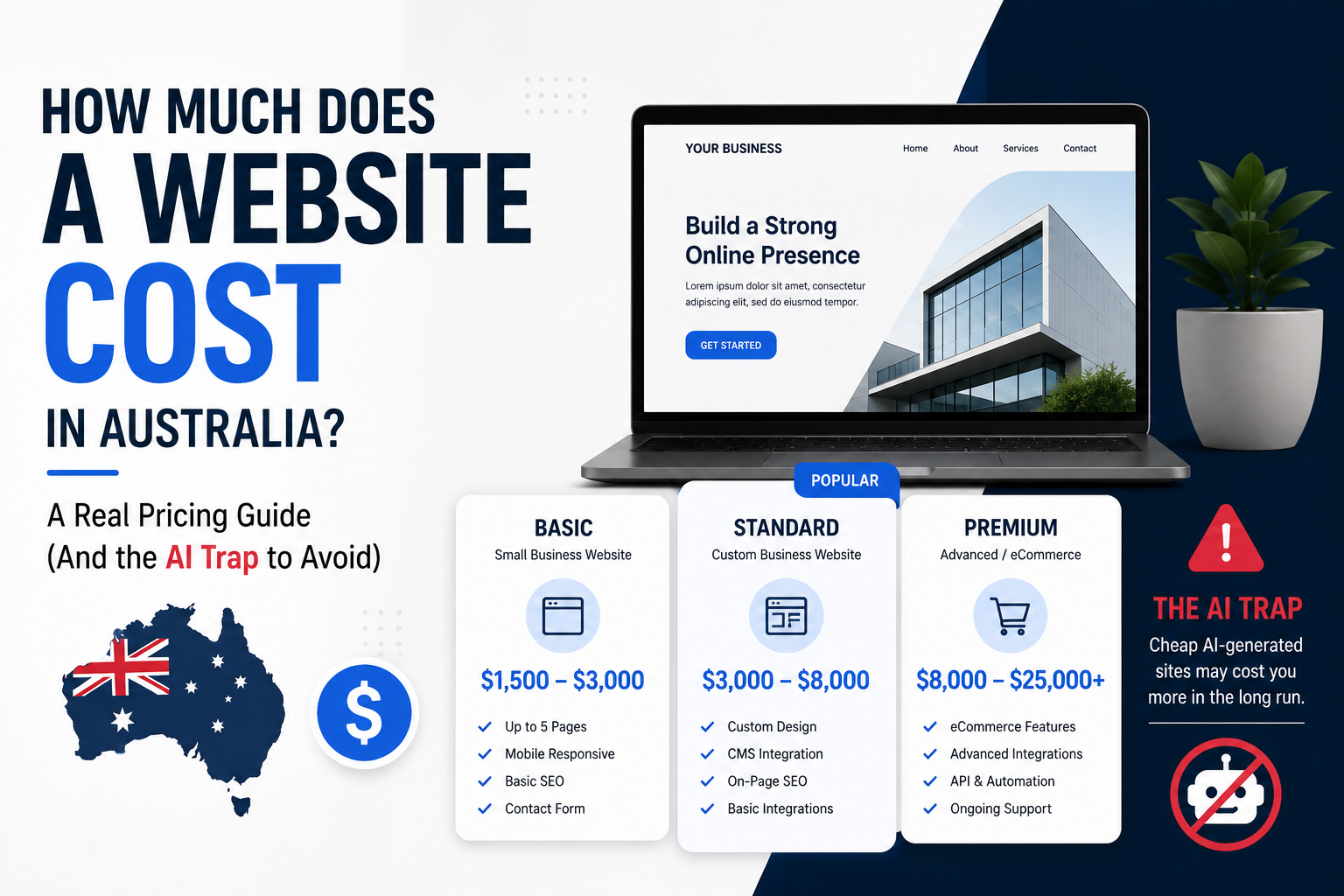
So you need a website. Maybe your old one looks tired. Maybe you’re starting fresh.
Either way, one question keeps popping up. How much does a website actually cost in Australia?
The honest answer is, it depends. A basic site might cost a few hundred dollars. A custom build can run into tens of thousands. There is no single number that fits every business.
But there is something new happening in 2026 that every Australian business owner should know about. Cheap AI generated websites are flooding the market. Some look fine at first glance. Many quietly hurt your search rankings, your credibility, and your sales.
This guide breaks down real Australian pricing, the hidden costs nobody mentions, and how to avoid the AI trap that is catching out so many small business owners right now.
Quick Answer: Average Website Cost in Australia
Here is a snapshot before we go deeper.
| Website Type | Typical Cost Range (AUD) | Best For |
|---|---|---|
| DIY website builder | $180 to $600 per year | Solo traders, hobby sites |
| Freelance built website | $800 to $5,000 | Small local businesses |
| Small agency website | $3,000 to $12,000 | Growing businesses |
| Custom ecommerce site | $8,000 to $30,000+ | Retailers, product sellers |
| Large business or enterprise site | $25,000 to $100,000+ | Franchises, corporate brands |
These figures reflect general market rates across Sydney, Melbourne, Brisbane, and Perth in 2026. Regional pricing can sit slightly lower.
Keep these numbers in mind. We will unpack why the range is so wide.
What Actually Affects Website Pricing in Australia
A website is not one product. It is a bundle of decisions, and each one changes the price.
1. Number of pages
A five page brochure site costs far less than a fifty page catalogue site. More pages mean more writing, more design, more testing.
2. Custom design versus template
Templates are quick and affordable. Custom design takes longer because every screen is built from scratch for your brand.
3. Functionality
Booking systems, payment gateways, membership areas, and quote calculators all add development hours. Hours cost money.
4. Content creation
Professional copywriting, photography, and video are often quoted separately. Skipping them saves money short term but often costs more in lost trust and lower rankings.
5. Ecommerce complexity
Selling ten products is simple. Selling ten thousand products across multiple marketplaces is a different job entirely. If you are already selling on Amazon or planning to expand there, it is worth reviewing how professional store setup and management services handle this, since website pricing and marketplace pricing often overlap more than people expect.
6. Ongoing support
Hosting, security updates, backups, and small edits are usually monthly or annual costs, not one off fees.
Website Pricing By Business Type in Australia
Different businesses need different builds. Here is a more realistic breakdown.
Local trades and services (electricians, plumbers, cleaners) Typical cost: $800 to $3,500 Usually a simple site with contact forms, service pages, and local SEO basics.
Cafes, restaurants, and hospitality Typical cost: $1,200 to $6,000 Often needs a menu page, booking integration, and strong photography.
Retail and ecommerce Typical cost: $5,000 to $30,000 Depends heavily on product count, payment integrations, and inventory syncing.
Professional services (accountants, lawyers, consultants) Typical cost: $2,000 to $10,000 Trust signals matter here. Design and clear copy carry more weight than flashy features.
Franchises and multi location brands Typical cost: $20,000 to $100,000+ Needs consistent branding across locations, plus centralised content management.
DIY Website Builders: The Budget Option
Platforms like Wix, Squarespace, and Shopify remain popular for a reason. They are affordable and fast.
Typical annual costs sit between $180 and $600, depending on the plan and add ons.
This route suits you if:
- You are testing an idea before investing heavily
- You have time to learn the platform yourself
- Your business does not depend heavily on search visibility
It is less suitable if you need strong SEO performance, complex functionality, or a design that truly stands apart from competitors using the same templates.
Freelancers Versus Agencies: What You Get For The Price
This is where most confusion happens. A freelancer and an agency can quote wildly different numbers for what sounds like the same job.
| Factor | Freelancer | Agency |
|---|---|---|
| Average cost | Lower | Higher |
| Turnaround time | Often faster for small jobs | Structured timelines |
| Team depth | Usually one person | Designers, developers, strategists |
| Long term support | Can be inconsistent | Usually included in contracts |
| Risk if unavailable | Higher | Lower, team based |
Neither option is automatically better. A skilled freelancer can outperform a mediocre agency. The right choice depends on your budget, timeline, and how much ongoing support you expect to need.
The AI Website Trap Australian Businesses Need To Watch For
Here is the part most pricing guides skip entirely.
AI website generators have exploded since 2024. Type a prompt, get a full site in minutes. It sounds too good to pass up. For some businesses, it genuinely helps as a fast starting point.
But there is a growing trap forming underneath the convenience.
The trap works like this.
- A business owner gets a cheap AI generated site for a few hundred dollars.
- The site looks acceptable on the surface.
- Underneath, the code is bloated, unindexed properly, or built on templates thousands of other sites already use.
- Google struggles to differentiate the content from countless similar AI generated pages.
- Rankings stay flat or slowly decline, while the business owner assumes the problem is something else entirely.
Google has been public about this shift. Its Search Central guidance states that content quality matters regardless of how it was produced, and that mass produced, low value content used to manipulate rankings can be treated as spam. This applies whether a human or an AI tool created it.
The real risk is not that AI tools are bad. Many are genuinely useful for drafting ideas. The risk is treating a fast AI output as a finished product without human review, original insight, or proper technical checks.
Signs you may have fallen into the AI website trap:
- The site was live within hours, with no strategy discussion beforehand
- Content reads generically and could apply to almost any business
- No one reviewed the site for Australian consumer law compliance
- There is no clear owner responsible for updates or fixes
- Search rankings have not moved in three months or more, despite regular posting
If any of these sound familiar, it does not mean starting over. It usually means the site needs a proper audit, some rewriting, and technical cleanup rather than a full rebuild.
Hidden Costs Most Quotes Do Not Mention
The sticker price is rarely the full price. Ask about these before signing anything.
- Domain registration, usually $15 to $40 per year
- Hosting, ranging from $10 a month for basic plans to $300+ a month for high traffic ecommerce
- SSL certificates, often included, but confirm this
- Stock photography or licensing fees
- Third party plugins or apps, especially for bookings and payments
- Content updates after launch, some agencies charge per hour, others include a set number of edits
- SEO work, which is frequently separate from the build itself
A website that looks like a $2,000 job on paper can quietly become a $4,000 job once these extras are added.
How To Budget For A Website The Smart Way
A short, practical process beats guesswork every time.
Step 1: Define what the site needs to do. Sell products, generate leads, or simply build credibility. Each goal changes the build.
Step 2: List must have features versus nice to have features. Booking systems and payment gateways are often must haves. Blogs and animations are often nice to haves.
Step 3: Get at least three quotes. Compare scope, not just price. A cheaper quote missing SEO setup is not actually cheaper.
Step 4: Ask about post launch support. Clarify what happens if something breaks in month four.
Step 5: Check past work. Ask for live examples, not just screenshots, and test them on a phone.
Frequently Asked Questions
Is it cheaper to build a website myself in Australia?
Yes, in upfront cost. DIY builders cost a few hundred dollars a year. The trade off is your own time, and often weaker SEO results compared to professionally built sites.
How much does a small business website cost in Australia in 2026?
Most small businesses spend between $800 and $6,000 for a professionally built site, depending on features and content needs.
Are AI generated websites bad for SEO?
Not automatically. The issue is low quality, generic content produced without human review or original insight, which search engines are increasingly able to identify.
How often should a business website be updated?
Small content updates monthly are ideal. A full design refresh every two to three years keeps a site feeling current.
Do I need to pay for hosting separately?
Usually yes. Some agencies bundle hosting into a monthly fee, while others expect clients to manage it independently.
What is a reasonable timeline for a website build?
Simple sites often take two to four weeks. Custom ecommerce or large multi page sites can take eight to twelve weeks or longer.
Final Thoughts
Website pricing in Australia is not a mystery once you understand what drives the number. Pages, features, content, and ongoing support all shape the final cost.
The bigger risk in 2026 is not overpaying. It is underpaying for a rushed, AI generated site with no strategy behind it, then wondering months later why nothing is working.
A website is one of the few assets that keeps working for your business around the clock. It deserves a budget that matches that job, and a plan built around your actual goals rather than the lowest number on a quote.
If you are weighing up options and want a second opinion on a quote, a build, or a stalled website, get in touch with our team for a straightforward conversation about what your business actually needs.