By Qii Creative | Digital Marketing Agency, Darwin, Australia
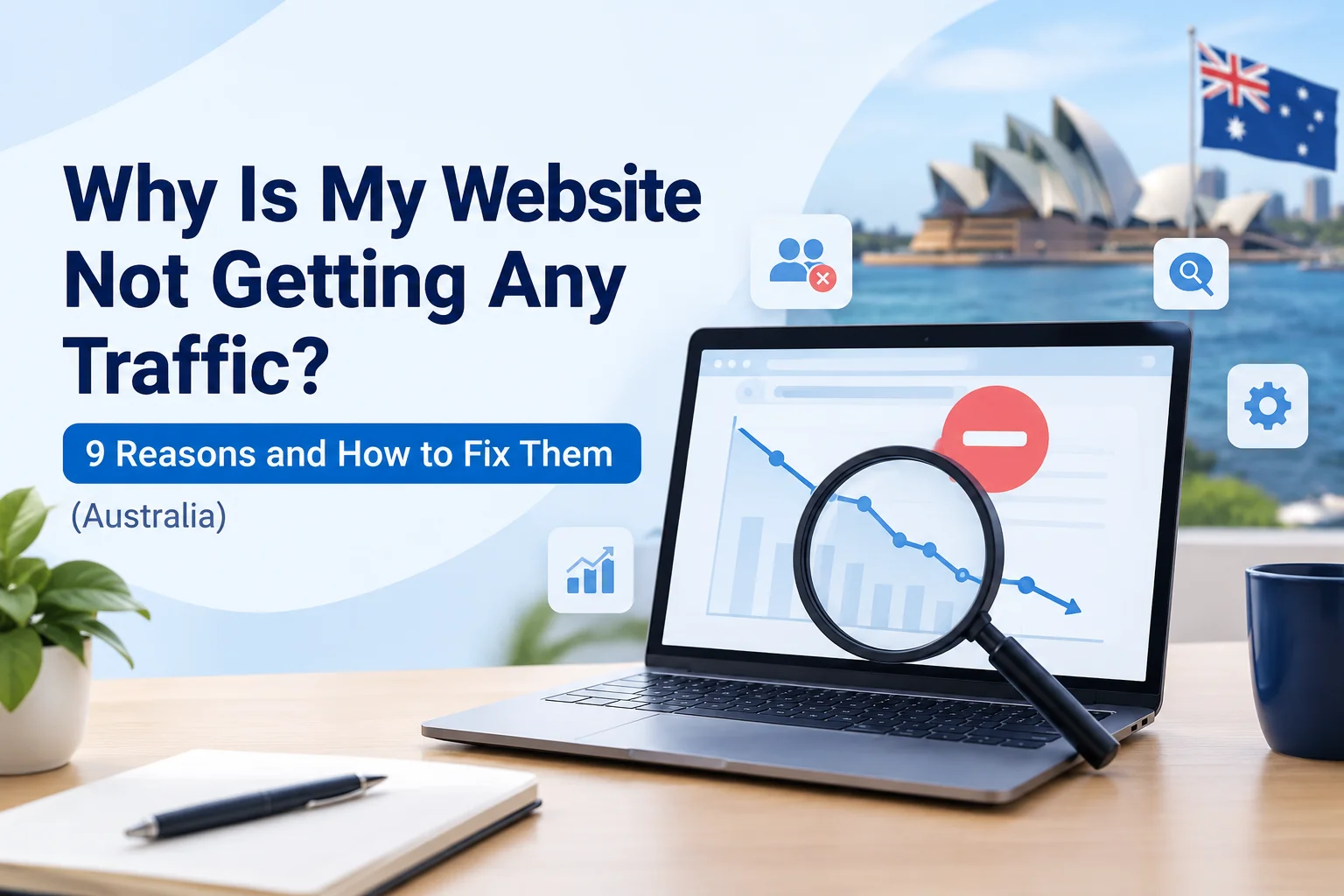
You paid for a website. It looks good. You shared it with friends, put it on your business card and waited. And then… nothing. A handful of visits a week, mostly from you.
If that sounds familiar, you are not alone. It is one of the most common problems Australian business owners bring to us, and the good news is that it is almost always fixable.
The short answer: a website gets no traffic when Google cannot find it, does not trust it, or has no reason to show it for the searches your customers make. The nine reasons below cover almost every case we see, and each one comes with a practical fix.
Quick Diagnosis: Which Problem Do You Have?
- Almost zero visitors, even for your own business name: start with Reason 1 (indexing) and Reason 3 (technical issues).
- Some visitors, but none from Google: start with Reasons 2, 4 and 6 (keywords, content, authority).
- Local business, but customers nearby cannot find you: go straight to Reason 5 (local SEO).
- Traffic, but no enquiries: that is a conversion problem. See Reason 7.
1. Google Has Not Indexed Your Website
If Google has not added your pages to its index, your site cannot appear in search results at all. This happens often with brand new sites, or when a developer left a “discourage search engines” setting switched on during the build.
How to check: type site:yourwebsite.com.au into Google. If nothing comes back, you have an indexing problem.
How to fix it:
- Set up Google Search Console and submit your XML sitemap.
- Check that your robots.txt file is not blocking important pages.
- In WordPress, confirm “Discourage search engines from indexing this site” is turned off.
- Use the URL Inspection tool to request indexing for your key pages.
2. You Are Not Targeting Keywords Your Customers Actually Search
Most business websites are written around what the owner wants to say, not what customers type into Google. If your homepage talks about “innovative solutions” and “quality service”, you are competing for nothing.
How to fix it:
- Research the exact phrases your customers use, such as “plumber Darwin” or “digital marketing agency Australia”.
- Give each service its own page, built around one main keyword.
- Put that keyword naturally in the page title, the main heading, the first paragraph and the URL.
- Match the search intent. Someone searching “how much does X cost” wants a pricing guide, not a sales pitch.
Keyword research and page mapping are the foundation of our SEO services, and they are usually where the biggest quick wins hide.
3. Technical Problems Are Holding Your Site Back
Even great content will not rank if your site is slow, broken on mobile or full of errors. Google wants to send people to pages that load quickly and work properly.
Common technical issues:
- Pages that take more than a few seconds to load
- A site that is hard to use on a phone
- Broken links and 404 errors
- Missing HTTPS security certificate
- Duplicate pages competing against each other
- Bloated images and heavy plugins
How to fix it: run your site through Google PageSpeed Insights and check the Page Indexing and Core Web Vitals reports in Search Console. A proper technical audit will list every issue in order of priority. We include this in our technical SEO and website audits.
4. Your Content Is Thin, Generic or Out of Date
A five-page website with 150 words on each page gives Google very little to work with. The same goes for copy that sounds like every other business in your industry.
How to fix it:
- Write service pages that actually answer questions: what you do, who it is for, how much it costs, how long it takes.
- Add a blog that targets the problems your customers search for.
- Use real examples, local references and your own experience. This is what Google calls experience and expertise.
- Update old pages. A page last touched in 2021 sends a weak signal.
As a rule, aim to be the most helpful page on the internet for that one search, not just another page that mentions it.
5. You Are Invisible in Local Search
If you serve a particular city or region, your biggest source of traffic is often Google Maps and the local results at the top of the page, not the regular blue links.
How to fix it:
- Claim and fully complete your Google Business Profile with the right category, services, hours, photos and description.
- Make sure your business name, address and phone number are identical everywhere online.
- Ask happy customers for Google reviews and reply to every one.
- Create location pages for each area you serve, with genuinely local content.
Local competition in smaller markets like Darwin and the Northern Territory is often much lower than in Sydney or Melbourne, which means well-executed local SEO can move quickly. That is exactly what our local SEO and Google Business Profile work focuses on.
6. You Have No Backlinks or Online Authority
Google treats links from other reputable websites as votes of confidence. If no one links to you, Google has little reason to rank you above competitors who have built up years of authority.
How to fix it:
- Get listed in trusted Australian business directories and industry associations.
- Partner with suppliers, local organisations and community groups who can link to you.
- Publish useful guides, data or tools that others want to reference.
- Pitch local media and industry blogs.
Avoid cheap link packages. Paid link schemes can earn a penalty that is far harder to fix than a lack of links.
7. Your Website Design Is Driving Visitors Away
This one is easy to miss. Traffic and design are linked: if visitors land on your site and leave within seconds, that behaviour tells Google the page did not help them.
Warning signs:
- Confusing navigation
- No clear call to action above the fold
- Walls of text with no structure
- An outdated look that does not build trust
- A slow or clunky mobile experience
How to fix it: make the next step obvious on every page, whether that is calling, booking or requesting a quote. If your site was built years ago and cannot easily be improved, a rebuild may cost less than the leads it is quietly losing. See how we approach web design and development and browse our case studies for examples such as Cars4Mates and MK PMC.
8. You Are Relying Only on Organic Traffic
SEO is powerful, but it is not instant. A new or recently relaunched website typically needs around three to six months of consistent work before organic results become meaningful. If you need enquiries now, waiting is not an option.
How to fix it: use paid search to fill the gap while your SEO builds.
- Run Google Search Ads on high-intent keywords such as “emergency electrician Darwin”.
- Set up conversion tracking so you know which clicks turn into calls and form fills.
- Send ad traffic to a focused landing page, not your homepage.
Paid ads can bring visitors within days. Managed well, they also teach you which keywords convert, which makes your SEO smarter. Our Google Ads management is built around exactly that: qualified leads first, vanity clicks never.
9. You Are Not Optimised for AI Search
Search is changing. More people now get answers from Google AI Overviews, ChatGPT and other AI tools before they ever click a website. If your content is vague or unstructured, these tools have nothing to quote, and your brand is left out of the conversation.
How to fix it:
- Answer common customer questions clearly and directly, near the top of the page.
- Add FAQ sections and use structured data (schema) so machines can understand your content.
- Build a consistent, trustworthy presence across your website, Google Business Profile, directories and reviews.
- Keep facts such as services, locations and pricing ranges accurate and easy to find.
This is called AI search optimisation, or GEO (Generative Engine Optimisation). Learn more about our AI search optimisation and AI development services.
Your 30-Minute Website Traffic Checklist
Work through this before you spend a dollar:
- Search
site:yourwebsite.com.auto confirm Google has indexed you. - Install Google Analytics and Google Search Console if you have not already.
- Test your site speed and mobile experience with PageSpeed Insights.
- Check that every service has its own page with a clear main keyword.
- Search your business name and your main service plus your city. Note where you appear.
- Check your Google Business Profile is complete and has recent reviews.
- Look at your competitors on page one. What do they have that you do not?
- Make sure every page has one clear call to action.
If you tick most of these and traffic is still flat, the issue is usually deeper than DIY fixes can solve.
How Long Until I See More Traffic?
It depends on the channel and your starting point.
- Google Ads: traffic can start within days of launch.
- Local SEO: early movement often appears within weeks to a few months.
- Organic SEO: meaningful results typically take around three to six months of consistent work.
- Web design improvements: usually 4 to 8 weeks to complete, with conversion gains starting once the new site is live.
Anyone who promises page one in a week is either guessing or cutting corners.
When to Get Professional Help
DIY is a great starting point, but it is time to bring in a specialist when:
- You have fixed the basics and nothing has changed
- You do not have time to manage SEO, ads and content yourself
- A previous agency left you with reports but no results
- You are losing enquiries to competitors who rank above you
At Qii Creative, we are a Darwin-based digital agency serving businesses across Australia. Our first 90 days follow a clear path: a full audit and goal-setting in the first month, launch and testing in the second, and scaling what works in the third. Read more about our team or see what our clients say.
Frequently Asked Questions
Why is my new website not showing up on Google?
New websites can take days or weeks to be crawled and indexed. Speed this up by submitting your sitemap in Google Search Console and requesting indexing for your main pages. Also check that nothing in your settings is blocking search engines.
How long does it take for a website to get traffic?
Paid ads can deliver visitors within days. Organic SEO usually takes around three to six months to show meaningful results, depending on competition, your industry and the quality of the work.
Why is my website getting traffic but no enquiries?
That is usually a conversion problem, not a traffic problem. Common causes include unclear calls to action, slow loading, weak trust signals such as reviews, or attracting the wrong audience with the wrong keywords.
Does my website need a blog to get traffic?
Not always, but a blog is one of the most reliable ways to target the questions customers search before they buy. It also builds authority and gives you content to link internally and share.
How much does it cost to fix a website with no traffic?
The cost depends on the cause. Some problems, such as an indexing error, can be fixed quickly. Others, like a full SEO strategy or a rebuild, are larger investments. A free audit is the best way to find out what you actually need before you commit.
Can a digital agency guarantee traffic?
No ethical agency can guarantee specific rankings, because Google controls them. What a good agency can do is show you a clear plan, transparent reporting and measurable progress tied to leads and revenue, not just visits.
Not Sure Why Your Website Is Not Getting Traffic?
Stop guessing. We will review your website, search visibility, ads and competitors, then show you exactly what is holding you back and what to fix first.
Get your free website and SEO audit from Qii Creative or call us on +61 480 334 185.