
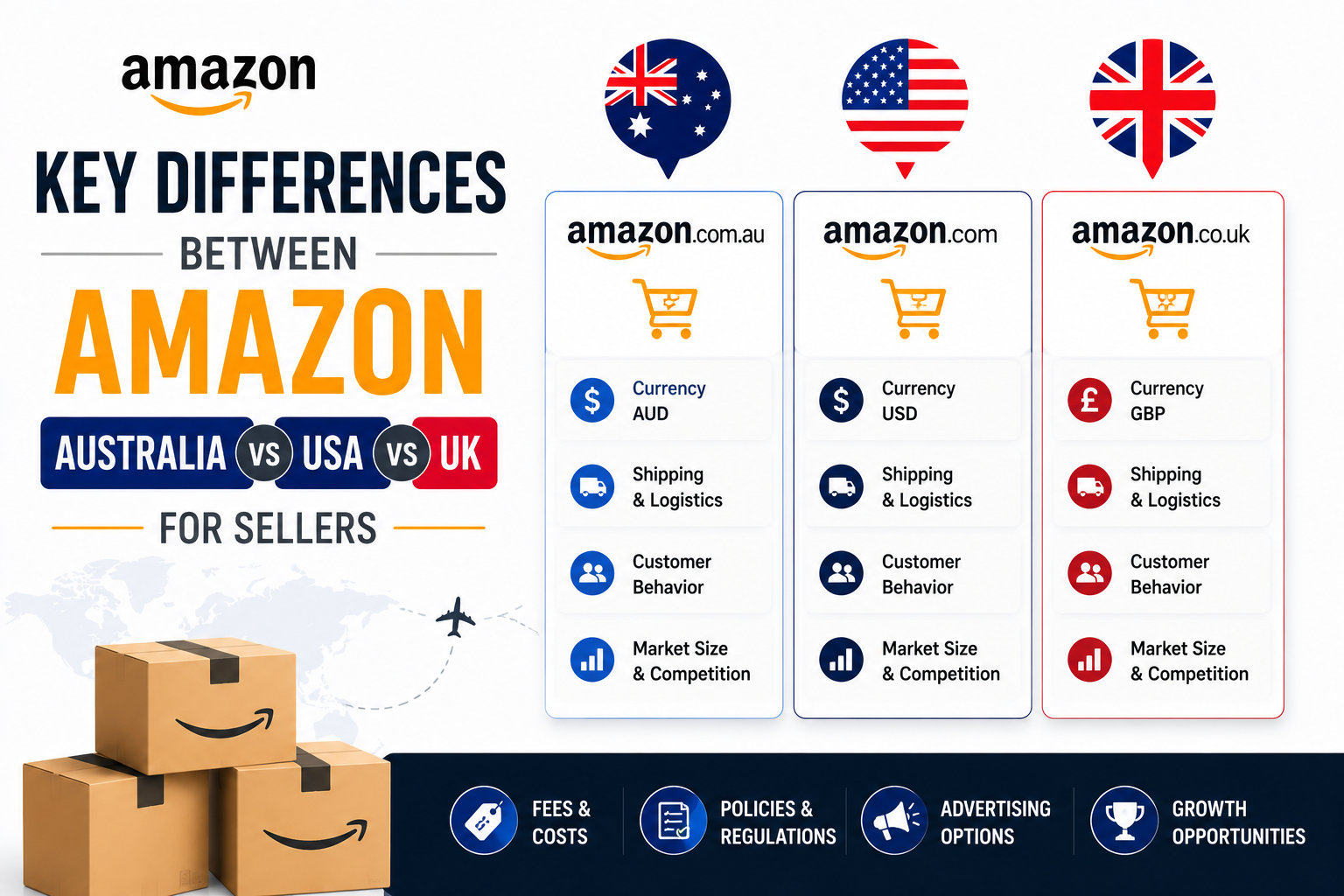
Thinking about selling on Amazon but not sure which marketplace fits your business? You are not alone.
Thousands of Australian sellers face this exact question every year. Amazon Australia, Amazon USA and Amazon UK each work differently. The fees differ. The tax rules differ. Even the customer expectations differ.
Picking the wrong marketplace first can cost you months of wasted setup time. It can also eat into your margins before you even make a sale.
This guide breaks down the real differences between these three marketplaces. We will look at fees, tax obligations, fulfilment options, competition levels and setup requirements. By the end, you will know exactly which marketplace suits your product and your stage of business.
Why Amazon Marketplaces Are Not All the Same
Many new sellers assume Amazon works the same everywhere. It does not.
Each country marketplace runs under local tax law, local consumer regulations and its own fee schedule. Amazon.com.au is a separate business entity from Amazon.com and Amazon.co.uk. Your seller account, your tax settings and your fulfilment network are all managed separately for each store.
This matters because a strategy that works on Amazon USA will not automatically translate to Amazon Australia. Category demand is different. Shipping distances are different. Even customer buying habits shift from one country to the next.
Understanding these gaps early helps you avoid costly mistakes later.
Amazon Australia vs USA vs UK: Quick Comparison
Here is a snapshot comparison to help you scan the key differences fast.
| Factor | Amazon Australia | Amazon USA | Amazon UK |
|---|---|---|---|
| Marketplace maturity | Younger, launched 2017 | Oldest and largest globally | Mature European hub |
| Individual plan fee | AUD 0.99 per item | USD 0.99 per item | GBP 0.75 per item |
| Professional plan fee | AUD 49.95 per month | USD 39.99 per month | GBP 25 per month |
| Typical referral fee | 6% to 15% | 8% to 15% | 8% to 15% |
| Consumption tax | 10% GST | No federal sales tax, state tax varies | 20% VAT |
| Competition level | Lower, growing fast | Very high, saturated in many categories | High, especially in top categories |
| Best suited for | Local brands, niche products | Scale and volume plays | European expansion |
Keep this table as a quick reference while reading the sections below, since each point is explained in more depth.
Seller Fees Compared Across the Three Marketplaces
Fees are usually the first thing sellers want to understand. They directly affect your profit margin.
Amazon Australia Fees
Amazon Australia offers two plans. The Individual plan costs 0.99 AUD per item sold, with no monthly charge. The Professional plan costs 49.95 AUD a month, excluding GST, no matter how many units you sell.
Referral fees on Amazon Australia generally sit between 6% and 15%, depending on category. Home and Kitchen products sit around 13%. Consumer Electronics sits closer to 8%. There is also a small minimum referral fee of one cent per item across all categories, which mainly affects very low priced listings.
Amazon USA Fees
Amazon USA also runs an Individual plan at 0.99 USD per item and a Professional plan at 39.99 USD monthly. Referral fees typically range from 8% to 15%, though some categories can reach 20% or higher.
The US marketplace has a minimum referral fee of one USD per item, slightly higher than Australia. Given the scale of Amazon USA, small percentage differences can add up quickly across large order volumes.
Amazon UK Fees
Amazon UK charges 0.75 GBP per item on the Individual plan. The Professional plan sits at 25 GBP a month, excluding VAT. Referral fees also range mostly between 8% and 15%, with some categories seeing recent reductions for lower priced items.
Amazon has also been trimming FBA fulfilment costs across UK and European stores, which is worth checking regularly since these rates shift with policy updates.
If you want a clearer sense of how these fees apply to your specific catalogue, working with a team that manages this daily can save considerable time. Services like Amazon store management can help Australian sellers set pricing that protects margin across every marketplace they list on.
GST, VAT and Sales Tax Rules for Sellers
Tax compliance trips up more new sellers than almost anything else. Each country handles it differently.
- Australia: GST is 10% and applies once your Australian sales exceed 75,000 AUD annually. Below that, GST registration is optional but sometimes still worthwhile for input tax credits.
- United States: There is no single federal sales tax. Instead, sales tax rates and rules vary state by state, and Amazon typically collects and remits this on the seller’s behalf through marketplace facilitator laws.
- United Kingdom: VAT sits at 20% for most goods. Sellers storing inventory in the UK, or exceeding certain thresholds, usually need UK VAT registration regardless of where their business is based.
For imported goods under 1,000 AUD entering Australia, GST is often collected at the border rather than by the seller directly. This is a detail many first time sellers miss, so it is worth double checking with a tax professional before you launch.
FBA and Fulfilment Differences
Fulfilment by Amazon, known as FBA, works in all three countries but the cost structure and speed expectations differ.
Fulfilment in Australia
Australia’s FBA network is smaller than the US or UK. Warehouses are concentrated around major cities like Sydney, Melbourne and Perth. Delivery across the country can still take longer due to geographic spread, especially to regional areas.
Fulfilment in the USA
The US FBA network is the largest in the world. Amazon operates hundreds of fulfilment centres, which allows for fast two day delivery in most regions. This scale also means fulfilment fees can vary more, based on product size tiers and seasonal storage surcharges.
Fulfilment in the UK
The UK network is smaller geographically but very dense, which keeps delivery times short. Amazon has also recently reduced parcel fulfilment fees across UK and European stores, making FBA slightly more affordable there compared to a few years ago.
Account Setup and Registration Requirements
Setting up a seller account looks similar on the surface but the paperwork differs by country.
- Australia: You need an Australian Business Number or equivalent business registration, plus bank details for payouts in AUD.
- USA: International sellers can register using a foreign business entity, though a US bank account or approved payment service usually smooths out payouts.
- UK: Sellers typically need a UK or EU VAT number if storing goods locally, along with standard business verification documents.
Amazon also runs identity verification checks that can take longer for new international sellers, so building in extra time before a planned launch date is a smart move.
Competition Level and Market Saturation
This is where the three marketplaces diverge sharply.
Amazon USA is the most saturated marketplace globally. Nearly every product category has established sellers, strong reviews and aggressive advertising spend. Breaking in requires either a genuinely unique product or a solid advertising budget.
Amazon UK sits somewhere in between. Competition is high in popular categories like home goods and beauty, but there is still room in more specific niches.
Amazon Australia remains comparatively less crowded. The marketplace is younger and still growing its seller base. For Australian sellers, this often means lower advertising costs and a real chance to rank organically without huge ad spend, at least for now.
Shipping, Logistics and Delivery Expectations
Australian customers are used to slightly longer delivery windows compared to US or UK shoppers, mainly due to the country’s size and lower population density outside major cities.
US customers expect fast delivery, often within one to two days for Prime eligible items. UK customers sit close to US expectations, helped by the country’s compact geography.
If you plan to sell across borders, from Australia into the US or UK for example, factor in longer international shipping times and customs handling. This can affect your delivery promises and customer satisfaction scores.
Which Marketplace Should You Start With?
There is no single right answer, but a few patterns tend to hold true for most sellers.
- Start with Amazon Australia if you are testing a new product, want lower competition, or are just beginning your ecommerce journey.
- Move to Amazon USA once you have proven demand and want to scale volume, understanding that competition and advertising costs will be higher.
- Consider Amazon UK if your product suits European tastes or you already have UK or EU business infrastructure in place.
Many sellers eventually run all three marketplaces together. That said, spreading yourself too thin early on often hurts more than it helps. Nail one marketplace first, then expand with a clear plan.
Tips for Australian Sellers Expanding Overseas
- Register for GST early if you expect to cross the 75,000 AUD threshold within the year.
- Keep separate spreadsheets or software tracking for each marketplace’s fees, since currencies and rates differ.
- Test pricing carefully. A price that works in AUD may not translate cleanly once converted to USD or GBP after fees.
- Watch shipping timelines closely if you plan to fulfil orders yourself across borders.
- Review Amazon’s fee updates every few months, since referral and fulfilment rates change more often than most sellers expect.
Frequently Asked Questions
Is Amazon Australia good for beginners?
Yes, generally. Lower competition and simpler local logistics make it a reasonable starting point for new Australian sellers.
Do Australian sellers need to register for VAT in the UK?
Only if you store inventory in the UK or exceed relevant thresholds. Selling occasionally into the UK from Australia without local storage usually does not trigger VAT registration, though rules can change, so it is worth confirming with an accountant.
Which Amazon marketplace has the lowest fees?
Amazon UK often has the lowest flat monthly fee at 25 GBP for Professional sellers, though referral fee percentages are broadly similar across all three marketplaces.
Can I sell on all three Amazon marketplaces at once? Yes, many sellers do. Each marketplace requires its own account setup, tax registration and inventory management, so plan for extra admin time.
How long does Amazon seller account approval take in Australia?
It usually takes a few days to a couple of weeks, depending on how quickly you submit verification documents.
Final Thoughts
Amazon Australia, USA and UK each offer real opportunity, but they are not interchangeable. Fees, tax rules, competition and fulfilment all shift from one marketplace to the next.
The smartest approach is to understand these differences before you commit budget and time. Start where the competition suits your stage of growth, then expand once you have a proven, profitable listing.
If you want help setting up or managing your Amazon store across any of these marketplaces, our team can walk you through the details specific to your product. Get in touch with us here to talk through your options.