Every Australian business owner knows the feeling. Support tickets keep piling up. Customers want answers now, not tomorrow. And hiring more staff just to keep up feels like throwing money at a problem that never actually gets solved.
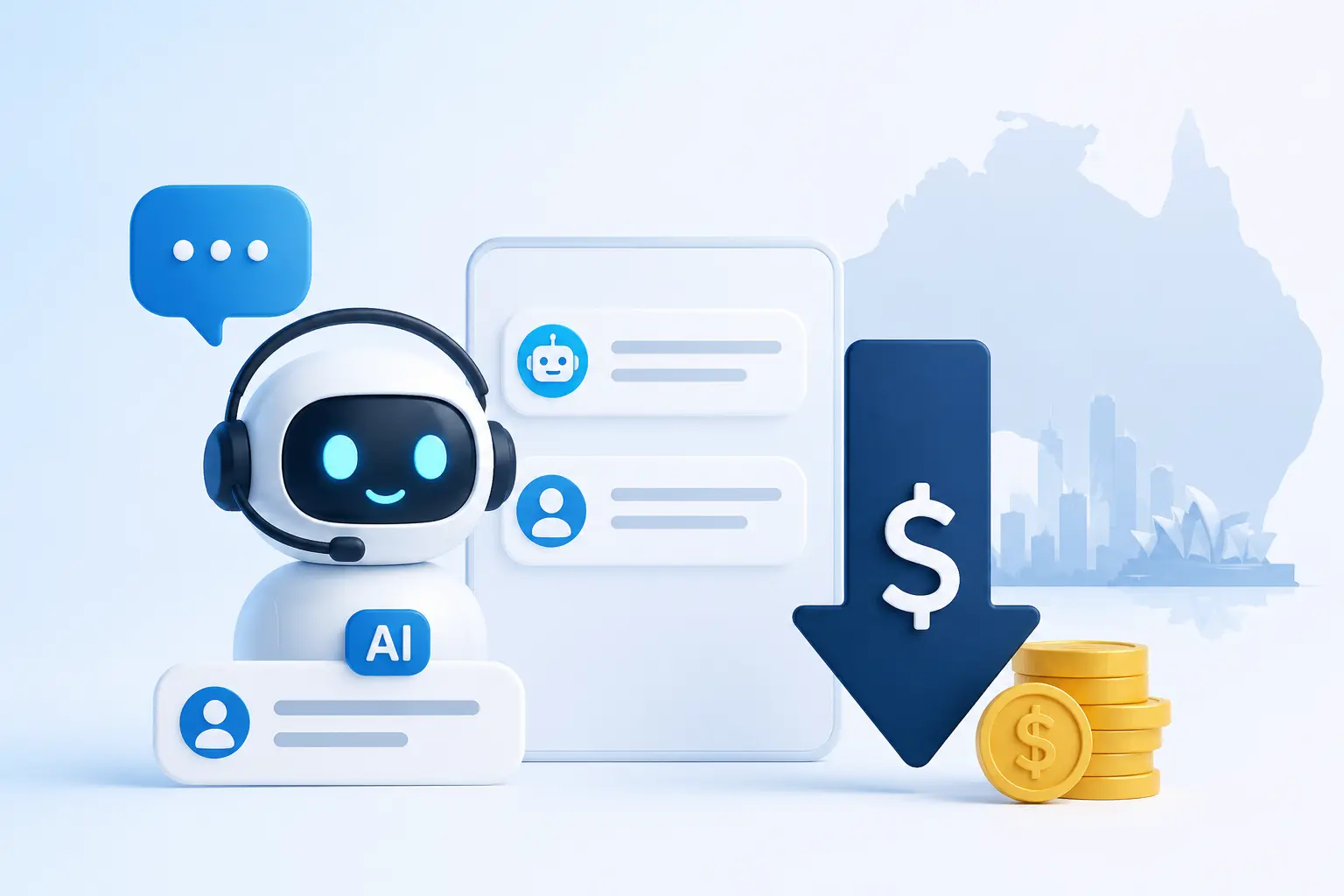
This is exactly where AI chatbots and large language models, or LLMs, are changing the game. They are not replacing your support team. They are taking the repetitive, time consuming work off their plate so your business can grow without your support costs growing just as fast.
In this guide, we will look at how AI powered customer support actually works, what it costs, what it saves, and how Australian brands are already using it to run leaner, faster support operations.
Why Australian Businesses Are Turning to AI for Customer Support
Customer expectations have shifted. People want instant replies, at any hour, on any channel. Most support teams simply cannot staff for that around the clock, at least not affordably.
The Australian chatbot market reflects this shift clearly. Industry research from IMARC Group values the local chatbot market at roughly USD 194.6 million in 2024, with growth expected to reach USD 1.45 billion by 2033. That is a compound annual growth rate above 22 percent, driven largely by demand for 24/7 support across retail, banking, and telecommunications.
A few forces are pushing this trend in Australia specifically.
- Rising wages and staffing costs in customer facing roles
- Customers expecting instant replies across chat, email, and social media
- Small businesses competing with larger brands that already offer always on support
- Government backed programs, such as the COSBOA backed Small Business PEAK initiative, showing that even public sector bodies trust AI chatbots to handle real enquiries
None of this means human support is going away. It means the easy, repetitive part of support is finally being automated properly.
The Real Cost of Traditional Customer Support in Australia
Before looking at savings, it helps to understand where the money actually goes in a typical support operation.
| Cost Area | Typical Impact |
|---|---|
| Salaries and overtime | Largest ongoing expense, especially for after hours coverage |
| Training and onboarding | Weeks of ramp up time per new hire |
| Staff turnover | Support roles have some of the highest churn rates in customer facing jobs |
| Missed enquiries after hours | Lost sales and frustrated customers who message competitors instead |
| Slow response times | Lower satisfaction scores and higher refund or complaint rates |
Most of these costs come from handling questions that do not actually need a human. Order status, opening hours, return policies, password resets, these are the questions eating up your team’s day.
How AI Chatbots Actually Cut Support Costs
AI does not save money by magic. It saves money by removing repetitive, low value work from your team’s plate. Here is how that plays out in practice.
Deflecting Repetitive Queries
Research from Desk365 and similar customer experience studies suggests AI chatbots can now handle up to 80 percent of routine support questions without human involvement. That includes order tracking, shipping timelines, FAQs, and basic troubleshooting.
Every question a chatbot resolves is one your human agents never have to touch.
24/7 Coverage Without Overtime
A chatbot does not clock off at 5pm. For Australian businesses juggling customers across different time zones, or simply people who shop and message after work hours, this closes a gap that used to mean lost sales or delayed replies.
Faster Resolution Times
Speed matters. One case study from iMoving showed a 47 percent improvement in response times after adopting an AI powered chat and quote system. Faster replies generally lead to fewer escalations and fewer frustrated follow up messages, which further reduces workload.
Scaling Without Hiring
This is the part that matters most for growing brands. When enquiry volume doubles during a sale or a new product launch, a chatbot scales instantly. Hiring and training new staff to handle the same spike takes weeks, and often leaves you overstaffed once demand settles back down.
LLM Powered Chatbots vs Older Rule Based Bots
Not all chatbots are built the same. This is where a lot of confusion happens, and where a lot of past disappointment with chatbots comes from.
| Feature | Rule Based Chatbot | LLM Powered Chatbot |
|---|---|---|
| Understands natural language | Limited, relies on exact keywords | Understands context and phrasing variations |
| Handles unexpected questions | Often fails or loops | Adapts and responds sensibly |
| Setup effort | Requires manual scripting for every path | Trained on your help centre, policies, and past tickets |
| Tone and personality | Rigid and robotic | Can match your brand voice |
| Escalation to humans | Basic handoff | Passes full context, so agents are not starting from scratch |
Older, rule based bots are why some business owners still associate chatbots with frustration. Modern LLM based systems, like the ones built on GPT and Claude style models, are a genuinely different category of tool.
If you are exploring what a properly built, LLM powered assistant could look like for your business, it is worth reviewing an AI development service built specifically for this kind of integration, rather than a generic off the shelf widget.
Real World Examples Worth Learning From
Numbers are more convincing with context behind them.
- Health insurer NIB reportedly saved around 22 million dollars through AI driven digital assistants, while cutting phone call volume by 15 percent and reducing the need for human support by 60 percent, according to reporting in The Australian.
- Vodafone uses AI chatbots to filter and manage routine customer enquiries, freeing up support staff to focus on complex account and billing issues.
- ServiceNow reports that its AI agents now handle 80 percent of support enquiries autonomously, cutting resolution time for complex cases by 52 percent.
These are not small pilot projects. They are large, ongoing deployments, which tells you the savings are real and repeatable, not a one off marketing story.
How Much Can Your Business Actually Save?
Every business is different, but a simple way to estimate potential savings is to look at ticket volume against resolution cost.
| Business Size | Estimated Monthly Tickets | Typical Deflection with LLM Chatbot | Estimated Monthly Savings |
|---|---|---|---|
| Small business | 200 to 500 | 50 to 65 percent | Equivalent to several hours of agent time weekly |
| Mid sized business | 1,000 to 5,000 | 60 to 75 percent | Often equal to one full time support role |
| Larger enterprise | 10,000 plus | 70 to 85 percent | Can offset multiple full time hires |
Gartner has projected that conversational AI will reduce global contact centre labour costs by roughly 80 billion US dollars by 2026. That is not a fringe prediction anymore, it reflects where budgets are already shifting.
Choosing the Right AI Chatbot for Your Business
Not every business needs the same setup. A five person online store has very different needs to a bank or a logistics company. Here is a simple way to think it through.
- Map your most common support questions first. If 60 percent of tickets are about three topics, start there.
- Decide which channels matter. Website chat, WhatsApp, Facebook Messenger, or email all need to be considered.
- Check how well it integrates with your existing systems, such as your CRM, order platform, or booking software.
- Confirm it can escalate to a human smoothly, with full conversation context passed along.
- Ask about data handling and whether it complies with Australian privacy requirements.
Skipping step one is the most common mistake. A chatbot trained on the wrong priorities will frustrate customers instead of helping them.
Common Concerns Aussie Business Owners Have About AI Support
Data Privacy and Compliance
This is usually the first question, and a fair one. Any AI system handling customer data in Australia should align with the Australian Privacy Principles under the Privacy Act. Reputable AI providers will be able to explain clearly where data is stored, how long it is retained, and how customer information is protected.
Losing the Personal Touch
Many business owners worry AI will make support feel cold. In practice, the opposite tends to happen. When AI takes the repetitive questions, human agents spend more time on the conversations that actually need empathy and judgement, not less.
Will Customers Even Use It
Consumer research from Tidio suggests over 67 percent of people globally have already interacted with a chatbot for support in the past year. Familiarity is no longer the barrier it once was.
Step by Step Guide to Getting Started
- Audit your last three months of support tickets to find repeat patterns.
- Choose an LLM based platform rather than a basic scripted bot.
- Feed it your help centre content, policies, and product information.
- Test it internally before rolling it out to real customers.
- Set clear escalation rules for when a human needs to step in.
- Review performance monthly and refine based on actual conversations, not assumptions.
Frequently Asked Questions
Do AI chatbots actually reduce costs, or just shift them somewhere else?
When implemented properly, they reduce costs by cutting the volume of repetitive tickets reaching paid staff. There is a setup cost, but it is generally recovered within months for businesses with meaningful support volume.
Can small Australian businesses afford this, or is it only for large brands?
Modern LLM based tools are far more accessible than older enterprise chatbot systems. Many small businesses now use them for after hours coverage alone, which is often enough to justify the cost.
Will an AI chatbot replace my support team?
Not usually. Most Australian businesses use AI to absorb repetitive questions, while keeping staff for complex, sensitive, or high value conversations.
How long does it take to see results?
Most businesses see measurable ticket deflection within the first four to six weeks, once the chatbot has been trained on real support data.
Is customer data safe with AI chatbots in Australia?
It should be, provided the provider follows the Australian Privacy Principles and is transparent about data storage and retention. Always confirm this before choosing a platform.
Final Thoughts
AI chatbots and LLMs are not a trend that Australian businesses can afford to ignore anymore. The cost pressure on support teams is real, and customer expectations keep rising alongside it. The businesses handling this well are not the ones with the biggest support teams. They are the ones using AI to remove repetitive work, so their people can focus on what actually needs a human.
If you want to explore what this could look like for your own support workflow, it is worth having a proper conversation about your specific ticket volume and systems before committing to anything. You can get in touch with the team to talk through what would actually make sense for your business.