
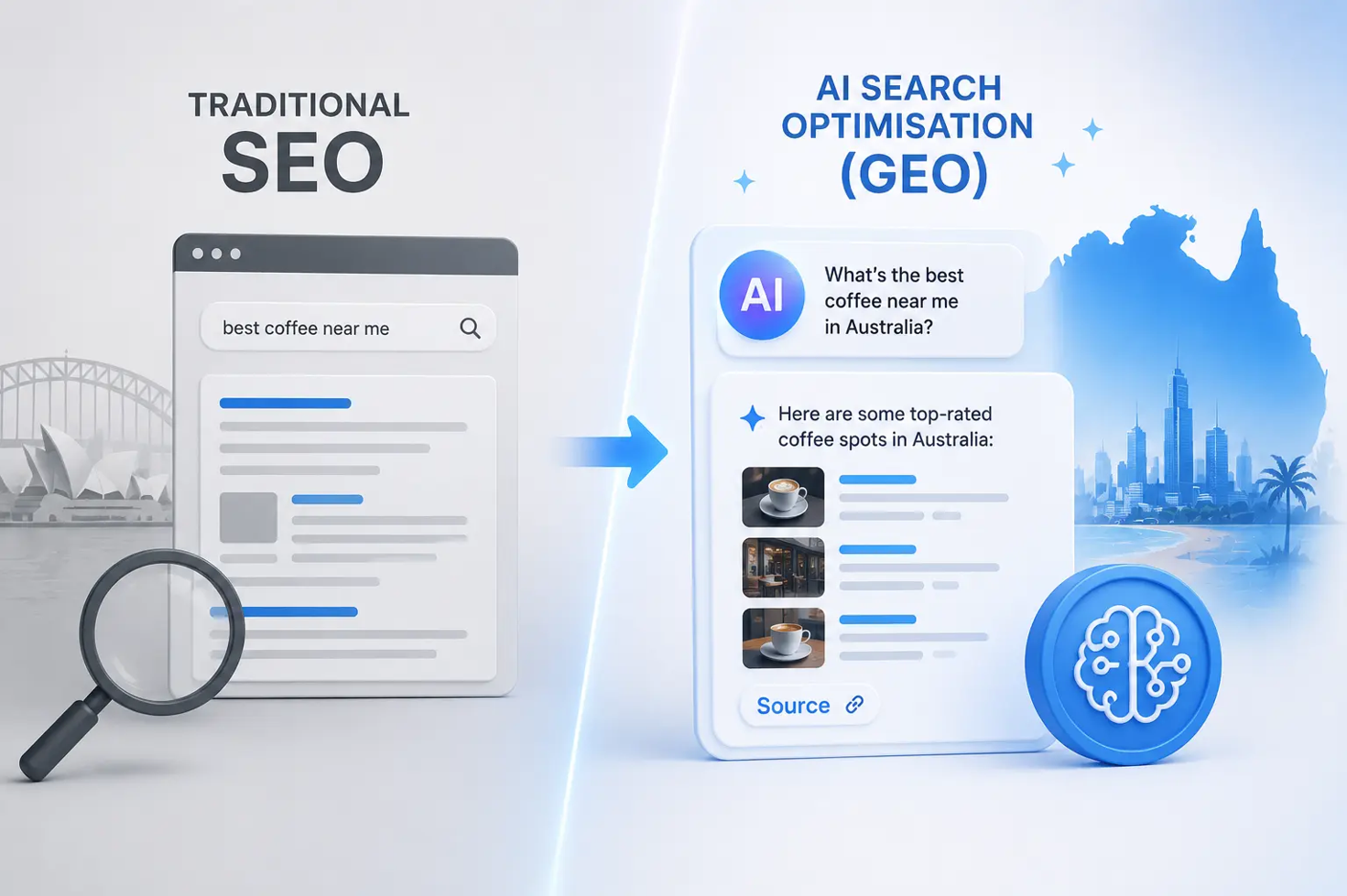
Search has changed. Quietly, but fast.
More Australians now ask ChatGPT a question instead of typing it into Google. Others get their answer straight from Google’s AI Overview, without clicking a single link. Perplexity users skip the search results page entirely and read a summary with sources attached.
If your brand isn’t showing up in these AI answers, you’re already losing visibility, even if you rank on page one of Google.
This is where AI Search Optimisation, often called Generative Engine Optimization or GEO, comes in. It’s not a replacement for SEO. It’s the next layer on top of it.
In this guide, we’ll break down what GEO actually means, why traditional SEO alone can’t carry your brand anymore, and how Australian businesses can start optimising for AI search engines like ChatGPT, Gemini, Perplexity, and Google AI Overviews.
What Is AI Search Optimisation (GEO)?
AI Search Optimisation, or GEO, is the practice of structuring content so AI engines can understand it, trust it, and cite it in generated answers.
Traditional SEO focuses on ranking a page in a list of ten blue links. GEO focuses on something different: getting your brand mentioned inside an AI generated answer, sometimes with a link, sometimes without one.
Think of it this way. SEO gets you a seat in the room. GEO gets you quoted in the conversation.
The term was first introduced in a 2023 research paper by Princeton, Georgia Tech, and Allen Institute researchers, who tested how content structure affects visibility inside AI generated responses. Their findings showed that adding citations, statistics, and clear quotations could boost visibility in AI answers by over 30 percent.
That’s not a small shift. That’s a new discipline.
Why Traditional SEO Isn’t Enough Anymore
SEO still matters. Rankings, backlinks, and technical health are not going away.
But SEO was built for a different kind of search behaviour. It assumes a person types a query, scans a results page, and clicks a link.
AI search doesn’t work like that anymore.
Here’s what’s changed:
- Users ask conversational, longer questions instead of short keywords.
- AI engines summarise multiple sources into one direct answer.
- Many users never click through to a website at all.
- Citations depend on content clarity, not just keyword placement or backlink count.
- Brand mentions can happen without a click, which changes how visibility is measured.
A 2025 Search Engine Land report noted that Google’s AI Overviews now appear on a large share of informational searches, and click through rates on those queries have dropped noticeably compared to traditional results.
For Australian brands, this means visibility inside AI answers is becoming a real ranking factor, one that classic SEO tactics don’t fully address.
How AI Search Engines Actually Work
Understanding GEO starts with understanding how these engines pull information.
1. Google AI Overviews
Google’s AI Overview scans top ranking pages, then generates a summary answer. It still leans heavily on traditional SEO signals like authority, structure, and relevance.
2. ChatGPT and Search Enabled Models
ChatGPT with browsing pulls live web data, prioritising pages with clear structure, direct answers, and credible sourcing. It tends to favour content that answers a question in the first two or three sentences.
3. Perplexity
Perplexity is citation heavy by design. It almost always shows source links next to its answers, which makes it one of the most GEO friendly platforms to optimise for.
4. Gemini
Gemini blends Google’s search index with conversational context, often pulling from pages that already rank well and have strong entity signals, like clear author names and business details.
5. Claude
Claude, when connected to search, prioritises accuracy and source clarity. It tends to favour content that states facts plainly, without fluff or exaggeration.
SEO vs GEO: What’s Actually Different
| Factor | Traditional SEO | AI Search Optimisation (GEO) |
|---|---|---|
| Main goal | Rank in search results | Get cited inside AI answers |
| Success metric | Clicks, rankings, impressions | Mentions, citations, brand visibility |
| Content style | Keyword focused | Answer focused, fact dense |
| Structure | Headings, meta tags | Clear statements, data, quotable lines |
| Trust signals | Backlinks, domain authority | Author expertise, source clarity, accuracy |
| User behaviour | Click to read | Read the summary, may not click |
Both systems reward good content. GEO simply adds a new layer of expectations on top.
Why This Matters for Australian Brands Specifically
Australia has one of the highest smartphone and voice assistant adoption rates globally, which naturally pushes more conversational, question based search behaviour.
Local businesses face an added challenge. Many AI engines struggle with location specific accuracy unless a brand’s information is clearly structured and consistent across the web.
For AU brands, this creates both a risk and an opportunity.
The risk: competitors get cited in AI answers for “best accounting firm in Sydney” or “reliable web developer in Melbourne,” while your brand stays invisible.
The opportunity: fewer Australian businesses are actively optimising for GEO right now, which means early movers have a real advantage.
Core Pillars of AI Search Optimisation
1. Answer the Question Early
AI engines favour content that answers the core question within the first few sentences. Save the storytelling for later in the piece.
2. Use Clear, Quotable Statements
Short, factual sentences get pulled into AI summaries more often than long, decorative paragraphs.
3. Show Real Expertise (E-E-A-T)
Google’s E-E-A-T framework, Experience, Expertise, Authoritativeness, and Trust, still applies. AI engines lean on the same signals: author credentials, original data, and consistent accuracy.
4. Structure Content for Machines and Humans
Use headings, bullet points, and tables. AI models parse structured content far more reliably than dense text blocks.
5. Back Claims With Data
Statistics, studies, and named sources make content more citable. Vague claims rarely get quoted.
6. Keep Information Consistent Everywhere
Your business name, service details, and location data should match across your website, Google Business Profile, and directories. Inconsistency confuses AI models.
Step by Step: How to Start Optimising for GEO
- Audit your existing content. Identify pages that answer real questions your customers ask.
- Rewrite intros to answer first. Lead with the answer, then explain the reasoning.
- Add structured data. Schema markup helps AI engines understand your content faster.
- Include original insights. Case studies, internal data, or expert commentary add citation value.
- Build topical depth. Cover a subject fully instead of spreading thin across many shallow pages.
- Monitor AI visibility. Search your brand terms inside ChatGPT, Perplexity, and Gemini regularly to check how you’re described.
- Strengthen technical foundations. Fast, mobile friendly, well structured websites still perform better across every engine.
Common Mistakes AU Brands Make With AI Search Optimisation
- Treating GEO as a separate strategy instead of an extension of SEO.
- Stuffing keywords instead of writing natural, direct answers.
- Ignoring author bios and expertise signals.
- Publishing content without any original data or insight.
- Failing to keep business information consistent across platforms.
Tips and Tricks for Better AI Citation
- Write like you’re explaining something to a smart friend, not a search engine.
- Break long paragraphs into two or three sentences.
- Use real numbers wherever possible, not vague terms like “many” or “most.”
- Add an FAQ section targeting exact questions people type into AI chatbots.
- Update older content regularly. AI engines favour fresh, accurate information.
Frequently Asked Questions
Is GEO replacing SEO?
No. GEO builds on SEO fundamentals. Technical health, authority, and relevance still matter for both traditional and AI search.
Do I need separate content for AI engines?
Not separate, but structured differently. Clear answers, data, and expertise signals help across both traditional and AI search.
How do I know if AI engines are citing my brand?
Ask ChatGPT, Perplexity, or Gemini questions related to your industry and location, then check if your brand appears in the response.
Does GEO work for small Australian businesses?
Yes. Local, well structured, and accurate content often has a real advantage, since many competitors haven’t optimised for this yet.
How long does it take to see results from GEO?
Most brands start seeing early citation improvements within two to three months of consistent, structured content updates.
Final Thoughts
Traditional SEO built the foundation. GEO is the next chapter on top of it.
Australian brands that adapt early will show up where their customers are already asking questions, inside AI generated answers, not just search results pages.
The shift is already happening. The only question is whether your brand is part of the conversation or missing from it.
If you want a clear plan for optimising your brand’s visibility across AI search engines, get in touch with our team and we’ll walk you through where you currently stand.