Walk into almost any small business in Australia today and you’ll find AI quietly doing work that once took hours. A cafe owner in Melbourne uses it to answer booking questions overnight. A Perth retailer uses it to restock inventory before it runs out. A Sydney tradie uses it to draft quotes in minutes, not days.
This isn’t a future trend anymore. It’s already happening across the country.
According to the National AI Centre, SME AI adoption in Australia reached around 44 per cent in February 2026, the strongest result in several months. Meanwhile, NAB Economics found that 42 per cent of Australian SMEs are already using AI, with another 14 per cent planning to adopt it soon. AiInsidesmallbusiness
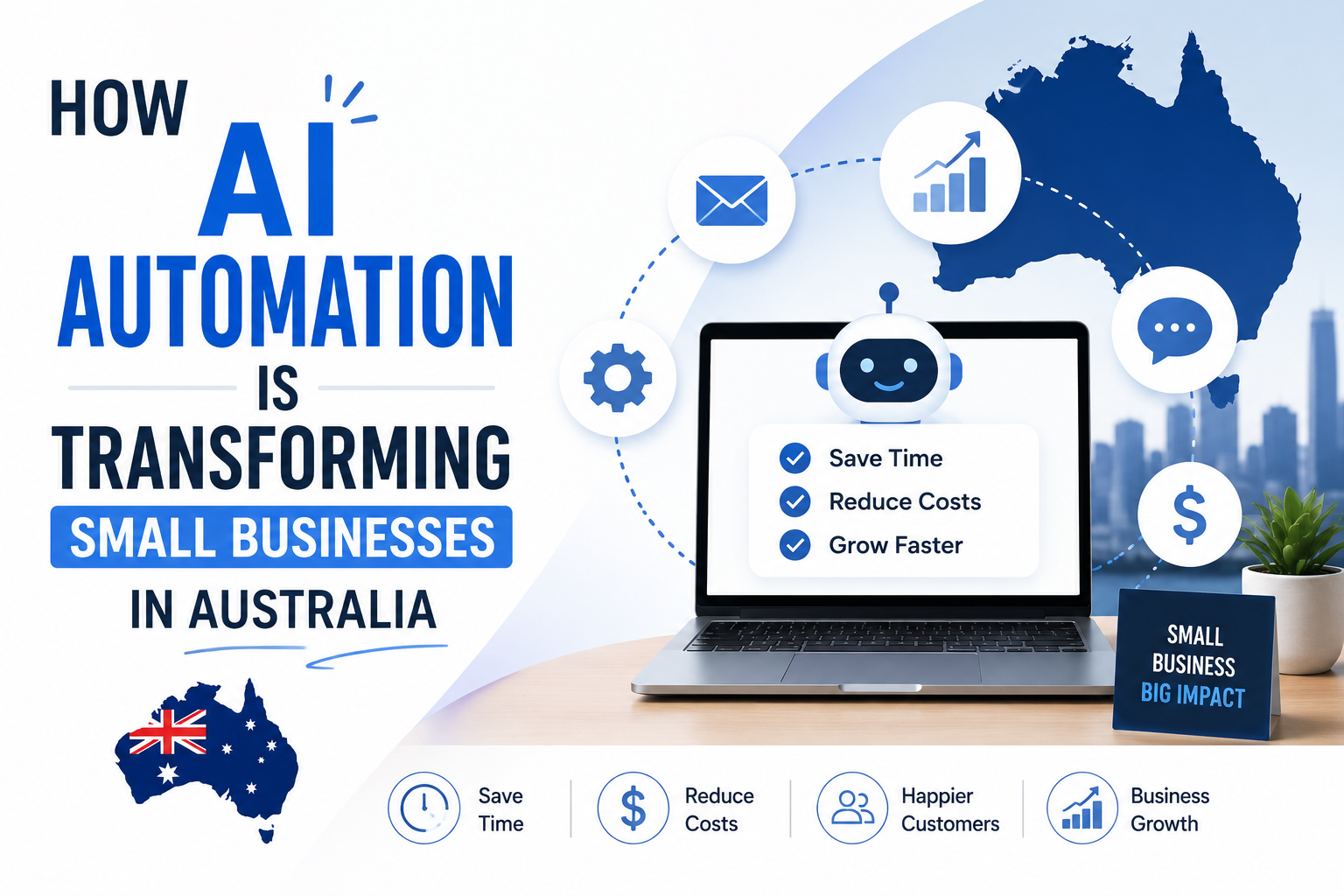
The numbers vary depending on how you define “using AI.” But the direction is clear. Small businesses across Australia are turning to automation to save time, reduce costs and compete with bigger players.
This guide breaks down exactly how that shift is playing out, what’s driving it, and what practical steps a small business owner can take right now.
What Does AI Automation Actually Mean for a Small Business?
AI automation simply means using software that can complete tasks without constant human input. It’s not about robots or science fiction. It’s about tools that:
- Answer customer questions automatically
- Sort and respond to emails
- Predict stock levels before you run short
- Write product descriptions or social captions
- Flag unusual patterns in sales or spending
For most small businesses, AI automation shows up in ordinary daily tasks. It rarely looks dramatic. It just quietly removes friction from the day.
Why Australian Small Businesses Are Adopting AI Right Now
A few forces are pushing this shift at the same time.
Rising costs. Wages, rent and supplier prices have all climbed. Automation helps owners do more without hiring more.
Customer expectations. Shoppers now expect fast replies, even outside business hours. A chatbot or automated email system fills that gap.
Tool accessibility. AI tools that once needed a developer are now available as simple apps, often for a low monthly fee.
Competitive pressure. Larger retailers and franchises already use AI for pricing, stock and service. Small businesses need similar tools just to keep pace.
The Australian Bureau of Statistics reported that around 12 per cent of Australian businesses used AI in their workplace during 2024 to 2025, with adoption clearly higher among businesses that actively pursued innovation. That gap between “innovation active” businesses and the rest is worth noting. Businesses that treat AI as part of a broader improvement plan tend to get far more value from it. Australian Bureau of Statistics
Australian AI Adoption Snapshot
| Source | Reported Adoption Rate | What It Measures |
|---|---|---|
| Australian Bureau of Statistics | 11 to 12% | Small and micro businesses using AI in the workplace |
| National AI Centre (Feb 2026) | 44% | SMEs using AI in any regular capacity |
| NAB Economics | 42% (plus 14% planning) | SMEs actively using or preparing to use AI |
| CSIRO (broad definition) | 68% | All businesses using any AI or machine learning tool |
Notice how much the numbers shift depending on definition. A narrow measure like “core AI system installed” gives a low number. A broad measure like “used any AI tool at all” gives a much higher one. Either way, the trend line is moving upward every quarter.
Key Areas Where AI Automation Is Changing Small Business Operations
Customer Service and Support
Chatbots and AI assistants now handle common questions around the clock. A customer asking about opening hours, delivery times or refund policy no longer waits for a reply during business hours.
This matters more in Australia than people realise. Many small businesses serve customers across different time zones, especially those selling online nationally or overseas. An automated first response keeps a customer engaged until a human can follow up properly.
Marketing, Content and Social Media
Small business owners rarely have a full marketing team. AI tools now help draft social captions, plan content calendars and generate first drafts of blog posts or email newsletters.
This doesn’t replace a human writer. It removes the blank page problem. A business owner can review and adjust a draft far faster than starting from nothing.
Online Store and Inventory Automation
For businesses selling online, AI now plays a big role in stock forecasting, pricing adjustments and order management. This is especially relevant for sellers on platforms like Amazon, where pricing and stock levels shift constantly and manual tracking becomes unmanageable at scale.
Automated tools can flag low stock before it becomes a lost sale, adjust pricing based on demand, and even suggest which products need attention. For Australian sellers managing an Amazon storefront, this kind of support can be the difference between steady growth and constant firefighting. Services like Amazon store management increasingly build AI driven tools into daily store operations for exactly this reason.
Bookkeeping, Admin and Compliance
Invoicing, expense tracking and basic bookkeeping are some of the most time consuming parts of running a small business. AI powered accounting tools now categorise expenses automatically, flag anomalies and prepare reports for tax time.
This frees up hours each week that owners previously spent buried in spreadsheets.
Sales, Quoting and Lead Follow Up
Many trades and service businesses lose potential jobs simply because a quote takes too long to send. AI tools can now draft quotes based on templates, follow up automatically with leads, and prioritise which enquiries need urgent attention.
Measurable Benefits Small Businesses Are Reporting
Based on current industry research and reported outcomes, small businesses using AI automation commonly see:
- Faster response times to customer enquiries, often reduced from hours to minutes
- Fewer stockouts and overstock situations for online sellers
- Reduced time spent on manual admin and bookkeeping each week
- More consistent content output for marketing and social media
- Better visibility into which leads or customers need follow up
Deloitte’s research estimated that AI could contribute around 44 billion dollars annually to the Australian economy, a figure that reflects productivity gains across businesses of every size, not just large corporations. FlowWorks
Common Barriers Holding Small Businesses Back
Adoption isn’t universal, and it’s worth being honest about why.
| Barrier | Why It Happens |
|---|---|
| Trust | Owners worry about accuracy, data privacy or losing personal touch with customers |
| Cost | Some tools still carry setup fees or ongoing subscription costs |
| Time | Learning a new system takes time owners feel they don’t have |
| Skills gap | Not every owner feels confident evaluating which tool actually fits their business |
The National AI Centre found that trust emerged as the single biggest reason Australian SMEs are not adopting AI, ahead of both cost and skills concerns. This is an important point. The barrier isn’t usually the technology itself. It’s confidence in using it correctly. Ai
How to Start Using AI Automation in Your Small Business
A simple, practical path works better than trying to automate everything at once.
- Pick one repetitive task. Choose something you do daily that eats up time, like answering the same customer questions or updating stock levels.
- Trial a small, affordable tool. Most AI tools now offer free trials. Test before committing to anything long term.
- Set a short review period. Give it two to four weeks, then check whether it actually saved time or improved accuracy.
- Expand gradually. Once one task runs smoothly, add a second one. Avoid overhauling every system at once.
- Keep a human check in place. Especially early on, review automated responses and outputs before they reach customers.
Tips for Getting Real Value From AI Automation
- Start with tasks that are repetitive, not tasks that need judgement.
- Choose tools built for your industry rather than generic all purpose software.
- Keep customer facing tone consistent, so automation still feels like your business.
- Track a simple metric before and after, like response time or hours saved.
- Revisit your tools every few months. This space changes quickly.
Frequently Asked Questions
Is AI automation only useful for large companies?
No. In fact, small businesses often see faster returns because a single automated task can free up a meaningful share of a small team’s total time.
What’s the easiest starting point for a small business new to AI?
Customer service automation, like an FAQ chatbot or automated email replies, tends to be the simplest and lowest risk starting point.
Does AI automation replace staff?
In most small businesses, it replaces repetitive tasks, not people. Staff typically shift toward higher value work like customer relationships and strategy.
How much does AI automation cost for a small business in Australia?
Costs vary widely, from free basic tools to monthly subscriptions of a few hundred dollars for more advanced systems. Many businesses start small and scale up.
Is customer data safe with AI tools?
Reputable AI tools follow data protection standards, but business owners should always check where data is stored and how it’s used before signing up.
Final Thoughts
AI automation isn’t replacing the character of Australian small business. It’s removing the parts that never needed a human touch in the first place, so owners can spend more time on the parts that do.
Adoption is rising steadily, barriers are mostly about trust rather than technology, and the businesses seeing real results are the ones starting small and building up gradually.
If you’re exploring how automation could support your own store or customer operations, it helps to talk it through with people who work with these systems daily. You can get in touch with our team to discuss what would actually make sense for your business.