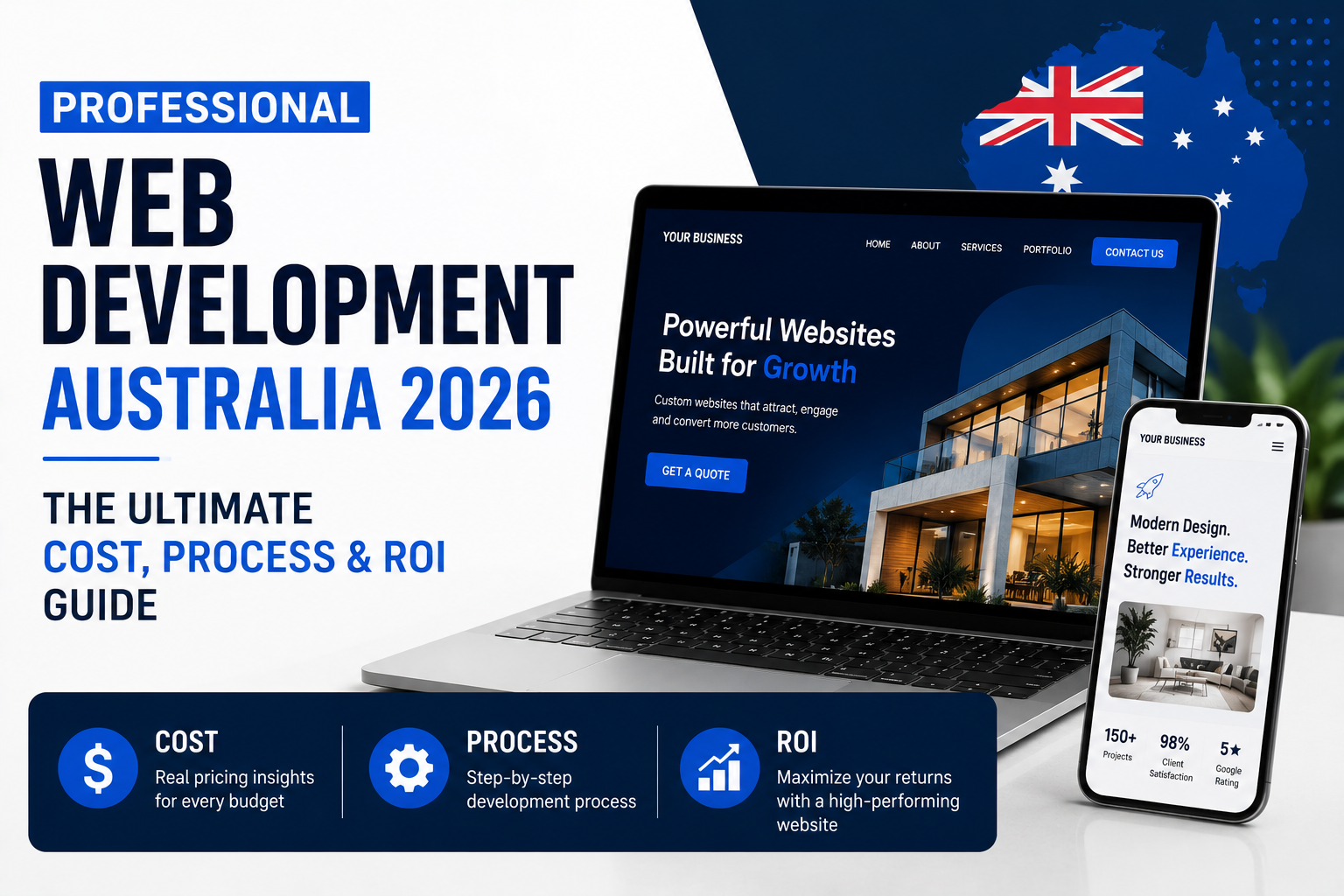
Getting a website built in Australia used to mean picking a template and hoping for the best. Not anymore. In 2026, a website is closer to a sales employee than a digital brochure. It works around the clock. It qualifies leads. It either makes you money or quietly costs you customers every single day.
If you are searching for professional web development in Australia, you probably have three questions on your mind. What does it actually cost? What does the process look like? And will it pay for itself?
This guide answers all three, using real market data, plain language, and zero fluff. No vague promises. Just the numbers, the process, and the decisions that matter.
Why Website Investment Decisions Feel So Confusing
Ask three Australian web development agencies for a quote on the same project. You will likely get three very different numbers. That is not a scam. It reflects genuine differences in experience, technology choice, and scope.
Business owners often say the same thing when comparing quotes. The range feels disorienting, even when everyone claims to be quoting for the same job.
The good news is that once you understand what drives the price, the confusion mostly disappears.
How Much Does Professional Web Development Cost in Australia in 2026?
Here is the honest range, based on current Australian market pricing.
| Website Type | Typical Cost (AUD) | Best Suited For |
|---|---|---|
| DIY builder (Wix, Squarespace) | $300 to $1,500 per year | Solo traders, very early stage businesses |
| Freelancer built brochure site | $1,500 to $5,000 | Small local businesses, simple service pages |
| Small agency business website | $5,000 to $20,000 | Growing businesses needing SEO and lead capture |
| Custom WordPress or Shopify build | $8,000 to $35,000 | Businesses needing integrations, ecommerce, or scale |
| Enterprise or custom web application | $50,000 to $200,000+ | Larger organisations, complex platforms, custom software |
Most Australian small and mid sized businesses land somewhere between $5,000 and $25,000 for a properly built, professional website with SEO foundations included.
Sydney and Melbourne agencies tend to sit at the higher end of this range. Perth, Adelaide and Brisbane based teams often deliver similar quality at slightly lower rates, partly due to lower operating costs in those cities.
What Actually Drives the Price Up or Down
A handful of factors explain most of the price gap between quotes.
- Number of pages and content complexity
- Custom design versus template based design
- Ecommerce functionality and payment gateway setup
- Integrations with CRMs, booking systems, or marketplaces
- SEO foundations built in from day one versus added later
- Ongoing hosting, maintenance, and security patching
- The experience level of the developer or agency
A cheap website with no SEO groundwork is rarely cheap in the long run. It usually needs rebuilding within two years, which means paying twice.
What Should Be Included in a Professional Web Development Package
Before signing off on any quote, check the proposal covers these basics.
- Mobile first responsive design. Most Australian traffic now arrives from phones, not desktops.
- Core Web Vitals optimisation. Page speed directly affects both rankings and conversions.
- On page SEO setup. Title tags, meta descriptions, header structure, and schema markup.
- Secure hosting with SSL. Non negotiable for trust and Google ranking signals.
- Analytics and tracking. Without data, you cannot measure return on investment.
- Content management system access. You should be able to update your own pages without calling a developer for every small change.
- Post launch support window. Bugs surface after launch. A good agency covers this without extra charges.
The Professional Web Development Process, Step by Step
A proper build follows a logical sequence. Skipping steps is usually where projects go wrong.
Step 1: Discovery and Strategy
The developer should ask about your business goals, target audience, and competitors before touching any design software. A site built without this step often looks nice but fails to convert.
Step 2: Wireframing and UX Planning
This stage maps out where content sits on each page. It focuses on user flow rather than colours or fonts.
Step 3: Visual Design
Branding, colour palette, typography, and imagery come together here. This is usually the stage clients get most excited about, since it is the first time the project feels real.
Step 4: Development and Build
The actual coding happens now, whether on WordPress, Shopify, or a custom framework. Backend functionality, forms, and integrations get built and tested.
Step 5: Content Upload and SEO Setup
Copy, images, and metadata get added. This is also when technical SEO elements like sitemaps and schema markup get configured.
Step 6: Testing and Quality Assurance
Every page gets checked across browsers and devices. Broken links, slow loading images, and form errors get fixed before launch, not after.
Step 7: Launch and Handover
The site goes live, along with training on how to use the content management system. A good agency also hands over analytics access and a basic maintenance plan.
Web Development Timelines in Australia
Timelines vary depending on scope, but here is a realistic breakdown for 2026 projects.
| Project Type | Typical Timeline |
|---|---|
| Simple brochure website | 1 to 2 weeks |
| Small business site with SEO | 2 to 4 weeks |
| Ecommerce store | 3 to 6 weeks |
| Custom web application | 6 to 12 weeks |
The biggest delay factor is rarely the developer. It is usually how quickly the client provides content, images, and approvals.
Ecommerce and Marketplace Integration
Many Australian businesses now sell through their own website alongside marketplaces like Amazon. If your web development project includes an online store, it is worth planning marketplace integration from the start rather than bolting it on later.
Businesses expanding into marketplace selling often benefit from specialist support for listing management and store optimisation, which is a different skill set to website design itself. If that applies to you, dedicated <a href=”https://qiicreative.com.au/services/amazon-store-management/”>Amazon store management</a> support can run alongside your website build so both channels work together rather than competing for attention.
Return on Investment: Does a Professional Website Actually Pay Off
This is the question that matters most, and it deserves honest treatment rather than a sales pitch.
A slow, poorly built website has a measurable cost. A one second delay in load time can reduce conversions by around seven percent. More than half of mobile visitors abandon a site that takes longer than three seconds to load.
That means a cheap, slow website is not actually cheap. It is quietly losing enquiries every single day, often without the business owner noticing.
On the other side, a well built site with proper SEO foundations compounds in value over time. Unlike paid ads, organic traffic from search engines does not stop the moment you stop spending.
Simple Ways to Measure Website ROI
- Track enquiry or lead form submissions monthly
- Monitor organic search traffic growth over 6 to 12 months
- Watch bounce rate and average time on page
- Compare cost per lead from the website against other channels
- Review conversion rate from visitor to enquiry or sale
Most businesses start seeing meaningful organic traffic gains within three to six months of launching an SEO optimised website, though this varies by industry and competition level.
E-E-A-T and Why It Matters for Australian Websites in 2026
Google’s Search Quality guidelines place heavy weight on Experience, Expertise, Authoritativeness, and Trust, often shortened to E-E-A-T. This is not a technical trick. It reflects real signals of a credible business.
Practically, this means your website should include:
- Genuine author or business credentials
- Real client testimonials and case studies, not stock quotes
- Clear contact details and business information
- Accurate, well researched content rather than thin filler pages
- Secure browsing and transparent privacy practices
Websites that demonstrate these signals tend to perform better in both traditional search rankings and in answers generated by AI tools like ChatGPT, Gemini, and Perplexity, which increasingly favour clearly sourced, trustworthy content over generic marketing copy.
DIY Website Builder Versus Professional Web Development
A common early decision is whether to use a DIY builder or hire a professional developer. Both have a place, depending on the stage of the business.
| Factor | DIY Builder | Professional Development |
|---|---|---|
| Upfront cost | Lower | Higher |
| Design flexibility | Limited to templates | Fully custom |
| SEO capability | Basic | Advanced, built in |
| Scalability | Limited | Built for growth |
| Time investment | High, self managed | Lower, handled by experts |
| Long term value | Often needs rebuilding | Built to last and grow |
DIY builders suit very early stage businesses testing an idea. Once a business is generating consistent revenue, professional development almost always pays for itself through better conversion rates and search visibility.
Common Mistakes Australian Businesses Make With Web Development
- Choosing the cheapest quote without checking what is excluded
- Skipping SEO setup to save a small amount upfront
- Ignoring mobile experience despite most traffic coming from phones
- Launching without analytics tracking in place
- Treating the website as a one time project instead of an ongoing asset
- Not planning for future growth, such as ecommerce or marketplace expansion
Tips for Choosing a Web Development Partner in Australia
- Ask to see real examples of past work, not just polished screenshots.
- Request a breakdown of what is included and what counts as an extra cost.
- Check whether SEO foundations are built in from the start.
- Ask about post launch support and how bugs are handled.
- Confirm you will have access to update your own content afterward.
- Ask about hosting, security, and who manages ongoing maintenance.
Frequently Asked Questions
How much does professional web development cost in Australia in 2026?
Most small and mid sized Australian businesses pay between $5,000 and $25,000 for a professionally built website with SEO foundations. Simple sites can start around $1,500, while custom platforms can exceed $50,000.
How long does it take to build a professional website?
A small business website typically takes two to four weeks. Ecommerce stores usually take three to six weeks, and custom web applications can take six to twelve weeks.
Is WordPress or a custom build better for Australian businesses?
WordPress suits businesses that need to update content frequently without developer help. Custom builds suit businesses needing unique functionality or planning significant scale.
Do I need SEO included in my website build?
Yes. A website without SEO foundations often fails to attract organic traffic, meaning the business ends up paying separately later to fix this.
What is a realistic ROI timeline for a new website?
Most businesses begin seeing measurable organic traffic and lead growth within three to six months, though this depends on industry competitiveness and content quality.
Final Thoughts
Professional web development in Australia is not about spending the most money. It is about matching your investment to your business stage, building on solid SEO foundations, and treating your website as a long term asset rather than a one off expense.
The businesses that get this right tend to see steady, compounding returns. The ones that cut corners usually end up paying twice, once for the cheap build and again for the rebuild.
If you are planning a new website or considering a rebuild, it helps to talk through your specific goals before committing to a scope or budget. You can get in touch here to discuss what makes sense for your business and timeline.