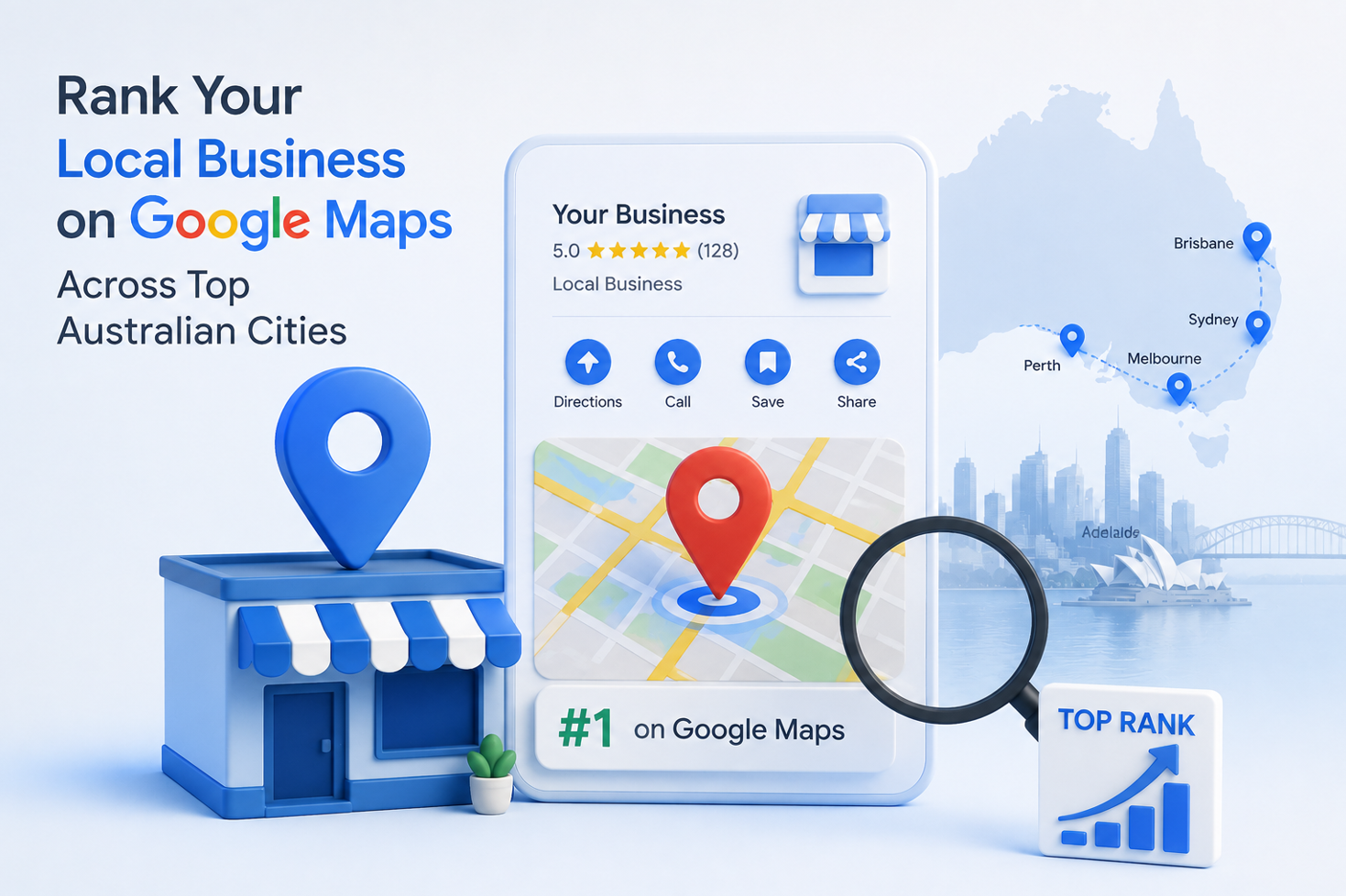
Picture this. Someone in Sydney searches “cafe near me” on their phone. Three results pop up on Google Maps. If your business isn’t one of them, you just lost a customer to someone else.
This happens thousands of times a day across Australia. Local search has quietly become the front door of small business. And Google Maps sits right at that door.
The good news? Ranking on Google Maps isn’t luck. It follows a clear set of signals. Once you understand them, you can work through them one by one.
This guide breaks down exactly how Google decides who shows up first. It also shows practical steps for businesses in Sydney, Melbourne, Brisbane, Perth, Adelaide, Gold Coast, Canberra and beyond.
Why Google Maps Rankings Matter So Much Right Now
Local search behaviour has shifted fast over the last two years.
Nearly half of all Google searches now carry local intent, meaning people are searching for something nearby, not just information. Businesses with a fully completed Google Business Profile also tend to earn far more clicks and calls than those with a half filled listing.
For Australian small businesses, this shift matters more than most industries realise. Australians are heavy mobile searchers. Someone driving through Parramatta or Fortitude Valley will check Maps before they check a website.
If your listing is missing, incomplete, or buried on page two, you’re invisible at the exact moment someone is ready to buy.
How Google Actually Ranks Local Businesses
Google has said for years that local ranking comes down to three core factors. Understanding these makes every tactic below make sense.
Relevance
This measures how well your business profile matches what someone typed into the search bar. Your category, business description, services list and even your reviews all feed this signal.
Distance
This is simply how close your business is to the person searching, or to the location they typed. You can’t control this directly, but you can widen your reach through service area settings and location specific content.
Prominence
This reflects how well known and trusted your business is, both online and offline. Reviews, backlinks, citations and general brand mentions all shape this signal.
Out of these three, relevance and prominence are the ones you can actually influence. Distance is mostly out of your hands, so smart business owners focus their energy elsewhere.
Step by Step Guide to Ranking on Google Maps
1. Claim and Fully Verify Your Google Business Profile
This is the single most important asset in local search today. A complete profile signals trust to Google faster than almost anything else.
Make sure you fill in:
- Business name exactly as it appears on your signage and invoices
- Correct address, matching Australia Post formatting
- Local phone number with the correct area code
- Accurate opening hours, including public holidays
- Website link and booking link if available
Half finished profiles quietly lose visibility, even with great reviews. Treat your profile like a shop window that never closes.
2. Choose the Right Categories
Your primary category is one of the strongest ranking levers you have. Pick the option that most precisely describes your core service, not the broadest one available.
A “family dentist” ranks better for dental searches than a business simply listed under “medical clinic.” Add secondary categories only where they genuinely apply.
3. Keep Your NAP Consistent Everywhere
NAP stands for Name, Address and Phone number. Google cross checks this data across the web to confirm your business is legitimate.
If your business is listed as “Smith Plumbing” on Google but “Smith Plumbing Pty Ltd” on a directory, that inconsistency can quietly weaken trust signals. Keep the details identical across your website, social pages and any online directory.
4. Collect Reviews, and Reply to Every One
Reviews influence both ranking and conversion. A steady stream of fresh, genuine reviews tells Google your business is active and trusted by real people.
A simple tip that works well: ask happy customers to mention the specific service they received. A review that says “great haircut and beard trim in Bondi” carries far more relevance weight than a generic five star rating with no detail.
Always reply, even to short reviews. It shows Google, and future customers, that someone is actively managing the business.
5. Post Regularly and Add Fresh Photos
Google Business Profile lets you publish short updates, offers and events directly on your listing. Businesses that post consistently tend to appear more active and engaged to both Google and searchers.
Photos matter too. Add real photos of your storefront, team and products rather than stock images. Update them every few months so your listing never feels stale.
6. Build Local Citations and Quality Backlinks
A citation is any mention of your business name, address and phone number on another website, such as a directory or industry association page. Consistent citations across trusted Australian directories reinforce your legitimacy.
Backlinks from local news sites, community pages or industry bodies also carry real weight. One quality link from a well known local source often outperforms dozens of low value directory listings.
7. Optimise Your Website for Local Search
Your website supports your Google profile rather than replacing it. It needs two things working together, useful content for people and clean structured data for search engines.
Create a dedicated page for each service you offer, written for real customers rather than stuffed with keywords. If you serve multiple suburbs or cities, build separate location pages rather than one broad page trying to cover everywhere at once.
An experienced SEO team can help structure this properly, especially if you’re expanding into new Australian cities and need location pages that actually convert.
Google Maps Ranking Tips Across Top Australian Cities
Local competition looks different in every city. Here’s a quick breakdown of what tends to matter most in each market.
| City | Local Search Behaviour | Key Focus Area |
|---|---|---|
| Sydney | High competition, dense suburbs | Suburb specific keywords, fast review growth |
| Melbourne | Strong local loyalty, foodie culture | Category precision, storytelling in descriptions |
| Brisbane | Growing population, rising search volume | Fresh photos, consistent posting |
| Perth | Smaller pool of competitors, high intent searches | Strong NAP consistency, local backlinks |
| Adelaide | Community focused, word of mouth still strong | Genuine reviews, local partnerships |
| Gold Coast | Tourism driven, seasonal spikes | Updated hours, seasonal posts and offers |
| Canberra | Government and professional services heavy | Trust signals, detailed service pages |
| Hobart and Darwin | Smaller markets, easier to dominate quickly | Full profile completion, early review collection |
The core steps stay the same everywhere. What changes is how aggressively you need to compete and which signal deserves your attention first.
Common Mistakes Australian Businesses Make
- Leaving the business description generic instead of specific to services offered
- Using a PO Box or virtual address, which can breach Google’s guidelines and hurt trust
- Ignoring negative reviews instead of responding calmly and professionally
- Forgetting to update holiday hours around Christmas, Easter or Australia Day
- Creating duplicate listings for the same business, which splits ranking signals
- Stuffing keywords into the business name, which can trigger a suspension
Avoiding these mistakes often does more for your ranking than any single “hack” ever will.
Tools That Help You Track Progress
You don’t need an expensive stack to monitor your Google Maps performance. A few reliable options include:
- Google Business Profile Insights, built directly into your dashboard
- Google Search Console, for tracking website visibility
- A rank tracking tool that checks Local Pack position by suburb
- Simple review monitoring through email alerts
Checking these monthly is usually enough for most small businesses. Weekly checks make sense only during a active campaign or new location launch.
Tips and Tricks for Faster Results
- Ask for reviews right after a positive interaction, not weeks later
- Use natural language in your business description, written the way a customer would search
- Add your city and suburb name naturally in photo captions and posts
- Respond to every review within 48 hours where possible
- Keep your service list updated as your offerings change
Small, consistent actions tend to beat occasional big pushes. Google rewards activity that looks steady over months, not bursts of effort followed by silence.
Frequently Asked Questions
How long does it take to rank on Google Maps in Australia?
Most businesses see noticeable movement within eight to twelve weeks of consistent optimisation, though highly competitive cities like Sydney and Melbourne can take longer.
Do I need a physical address to rank on Google Maps?
Yes, for most business types. Service area businesses without a public facing storefront can hide their address but still need a verified physical location.
Does responding to reviews actually affect ranking?
Yes. Active engagement is one of the behavioural signals Google factors into prominence, alongside review volume and recency.
Can one business rank in multiple Australian cities?
Only if you have a genuine, verifiable presence in each location. Google does not allow fake addresses purely to rank in extra cities.
Is Google Maps ranking different from normal Google search ranking?
Yes. Maps ranking focuses heavily on relevance, distance and prominence, while organic search ranking weighs content quality and backlinks more broadly, though the two do overlap.
Final Thoughts
Ranking on Google Maps isn’t about chasing a trick that works this month and disappears the next. It’s about steadily building a profile Google can trust, city by city, review by review.
Start with the basics. Complete your profile, choose the right category, keep your details consistent, and ask happy customers to leave a review. Everything else builds on that foundation.
If you’d like a clear plan built around your specific city and industry, get in touch with our team and we’ll walk you through what actually needs attention first.