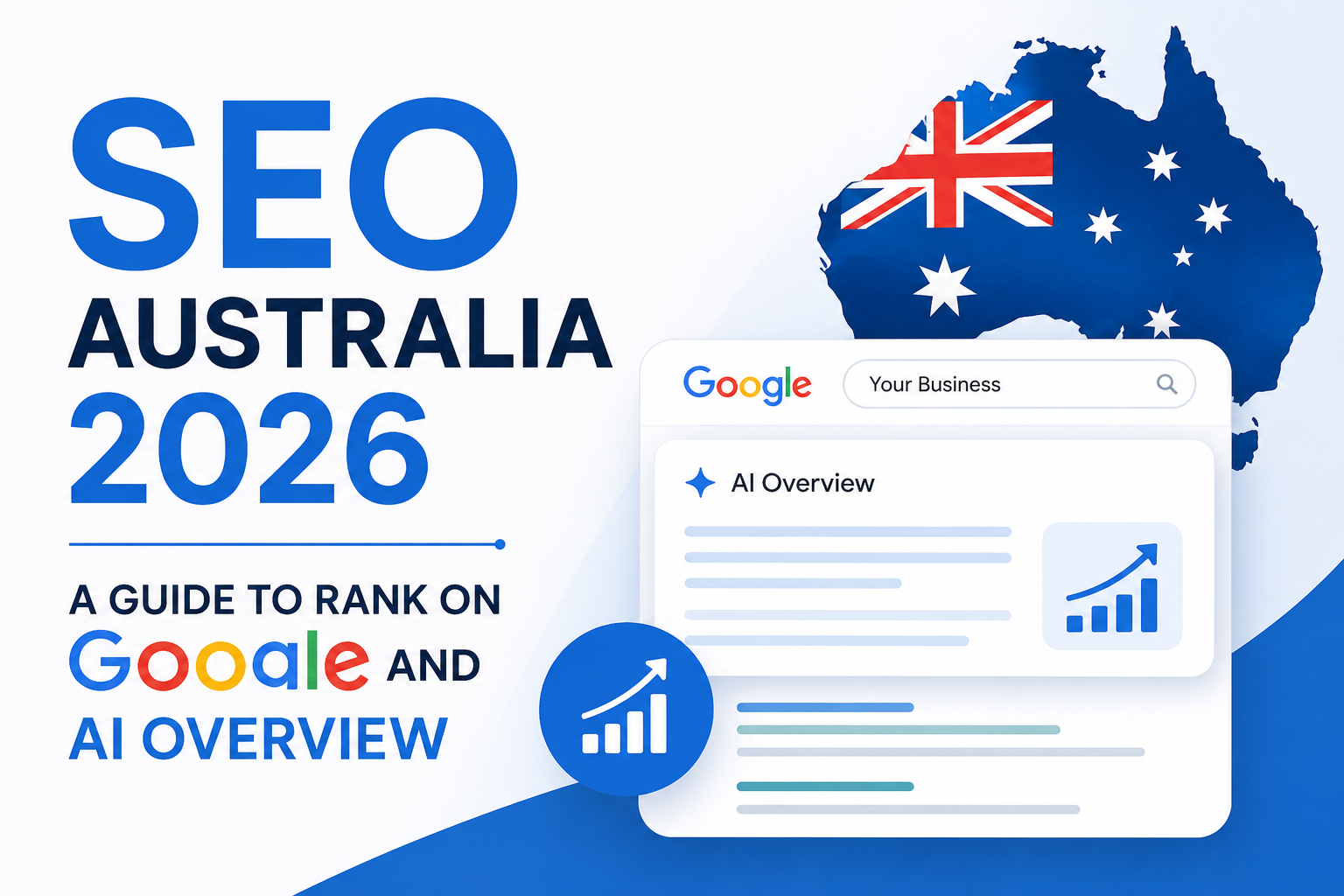
Search has changed more in the last two years than in the previous decade. If you run a business in Sydney, Melbourne, Brisbane or anywhere else in Australia, you have probably noticed it too. People still type into Google. But now Google often answers them directly, right there in an AI Overview, before they even click a link.
At the same time, more Australians are asking questions inside ChatGPT, Gemini and Perplexity instead of typing into a search bar. That shift matters. It means ranking on page one is no longer enough. Your content also needs to earn a spot inside the answer itself.
This guide breaks down what actually works in 2026. No fluff, no recycled tips from 2019. Just practical steps to help your website rank on Google and get cited by AI engines.
Why SEO Looks Different in Australia in 2026
Australian search behaviour has its own quirks. Local intent matters more here than in bigger markets like the US.
People searching from Perth or Adelaide often add location terms without thinking. Phrases like “near me”, suburb names, or “in Australia” show up constantly in search data. Google picks up on this fast.
On top of that, Australian users tend to trust local reviews and local business listings more than generic global content. That is why a strong Google Business Profile often outranks a beautifully written blog post for local searches.
Three things are shaping SEO in Australia right now.
- Google’s AI Overview now appears on a large share of informational searches, including many with commercial intent.
- Voice and conversational search continues to grow, especially through mobile devices.
- Trust signals, real reviews, real authors, real business details, carry more weight than ever.
Google’s E E A T and Why It Matters More Than Before
E E A T stands for Experience, Expertise, Authoritativeness and Trust. Google has used this framework for years, but it has become far stricter since the Helpful Content updates rolled out.
Here is the simple version. Google wants to know if the person or business behind the content actually knows what they are talking about.
For Australian websites, this usually means:
- Show a real author name and bio, not just “Admin” or “Team”.
- Include genuine business details, an ABN, a physical address, a phone number.
- Back up claims with data, case studies or first hand experience.
- Keep content updated when facts, prices or regulations change.
Content written purely to rank, without real experience behind it, tends to get filtered out quietly. It might still be indexed, but it rarely shows up in the top results or inside an AI Overview.
What Is an AI Overview and Why Should You Care
An AI Overview is the summarised answer Google shows at the top of search results for many queries. Instead of ten blue links, users see a written answer first, often pulled from several sources at once.
This changes the game for site owners. Ranking in position one on a traditional list does not guarantee a click anymore. If your content is not clear, well structured and factual, Google may skip it when generating that summary, even if you rank well below the fold.
The good news is that AI Overviews still pull from real websites. Being the source behind that answer, even without a click, builds brand visibility and trust over time.
Generative Engine Optimization Explained
Generative Engine Optimization, often shortened to GEO, is the practice of structuring content so AI systems can understand, trust and quote it.
This is different from writing purely for a search engine’s ranking algorithm. GEO focuses on how tools like ChatGPT, Gemini, Perplexity and Claude read, summarise and cite information.
Here is a simple comparison to make the difference clear.
| Traditional SEO | Generative Engine Optimization |
|---|---|
| Focuses on keyword placement and backlinks | Focuses on clarity, structure and factual accuracy |
| Goal is a high ranking position | Goal is being quoted or cited in an AI answer |
| Success measured by clicks and traffic | Success measured by citations and brand mentions |
| Content optimised for crawlers | Content optimised for both crawlers and language models |
Both approaches work together. You still need solid technical SEO. But GEO adds a second layer on top of it.
How ChatGPT, Gemini, Perplexity and Claude Choose What to Cite
AI models do not cite content randomly. They tend to favour sources that are clear, well organised and easy to extract facts from.
Based on how these tools currently behave, a few patterns stand out.
- Short, direct sentences get quoted more often than long, winding paragraphs.
- Clear headings that match common questions help the model locate the right section fast.
- Original data, statistics or examples give the model something specific to reference.
- Pages with a clear author and publish date are treated as more reliable sources.
- Content that answers a question directly, within the first sentence or two, tends to get picked up first.
If you want your Australian business to show up when someone asks an AI assistant a question, write like you are answering a real person, not stuffing keywords for a bot.
On Page SEO Tips That Still Work in 2026
Good on page SEO has not disappeared. It has just become more about clarity than tricks.
Here is what still moves the needle.
- Write one clear, specific title tag per page, ideally under 60 characters.
- Use a single H1 that matches the main search intent of the page.
- Break content into short paragraphs, most under three sentences.
- Add a table or list wherever you are comparing options or steps.
- Use descriptive image alt text, especially for product or service photos.
- Link to related pages on your own site where it genuinely helps the reader.
Avoid keyword stuffing entirely. Google’s systems, and AI models too, can tell when text is written for a machine instead of a human.
Technical SEO Checklist for Australian Websites
Technical health still forms the foundation everything else sits on. A brilliant article on a slow, broken website rarely ranks well.
Run through this checklist regularly.
- Check your site loads in under three seconds on mobile.
- Confirm your site is fully mobile friendly, since most Australian searches happen on phones.
- Fix broken links and redirect chains.
- Make sure your site has a valid SSL certificate.
- Submit an updated XML sitemap through Google Search Console.
- Check Core Web Vitals scores and fix anything flagged as poor.
If you are unsure where your site stands technically, a proper SEO audit and optimisation service can pinpoint issues that are quietly holding your rankings back.
Local SEO for Australian Businesses
For any business serving a specific city or suburb, local SEO often delivers the fastest results.
Start with your Google Business Profile. Keep your business name, address and phone number consistent everywhere online. Add real photos, update your hours, and respond to reviews.
A few extra steps that help Australian businesses specifically:
- List your business on trusted local directories, not just generic global ones.
- Encourage genuine customer reviews, since fake or incentivised reviews are easy to spot and can backfire.
- Create location specific pages if you serve multiple cities or regions.
- Mention nearby landmarks or suburbs naturally in your content, where relevant.
Local trust signals feed directly into both Google rankings and AI Overview results for “near me” style searches.
Content Strategy That Gets Cited by AI Engines
Writing content that AI tools want to quote is not about tricking the system. It is about being genuinely useful and specific.
A few habits worth building into your content process:
- Answer the exact question in your first paragraph, then expand with detail after.
- Include real numbers, dates and sources wherever possible.
- Update older posts instead of letting them go stale.
- Add FAQ sections that mirror how people actually phrase questions.
- Keep a consistent tone across your site, since consistency builds trust over time.
Storytelling still has a place too. A short example or case study makes content more memorable, for humans and for the patterns AI models learn to trust.
Common SEO Mistakes Australian Businesses Still Make
Even experienced business owners fall into a few recurring traps.
- Ignoring mobile users, despite mobile making up most Australian search traffic.
- Publishing thin content just to hit a word count.
- Copying competitor content instead of adding original insight.
- Neglecting Google Business Profile updates for months at a time.
- Focusing only on rankings, while ignoring AI Overview visibility entirely.
Fixing even two or three of these often produces a noticeable improvement within a few months.
A Quick Look at the Numbers
Search behaviour data from recent years gives a useful snapshot of where things stand.
| Trend | What It Means for Australian Businesses |
|---|---|
| AI Overviews appear on a large share of informational queries | Content needs to be answer first, not buried in fluff |
| Mobile makes up the majority of local searches | Mobile speed and usability are non negotiable |
| Reviews influence local ranking and consumer trust | Active review management is now part of SEO, not separate from it |
| Voice search queries tend to be longer and more conversational | Content should answer natural, spoken style questions |
These are general industry patterns, not fixed numbers, since search algorithms shift constantly. Treat them as direction, not gospel.
Step by Step Guide to Start Improving Your Rankings
If you are starting from scratch, here is a simple order to follow.
- Run a technical audit and fix any major site speed or mobile issues.
- Claim and fully complete your Google Business Profile.
- Review your top ten pages and rewrite intros to answer the main question immediately.
- Add FAQ sections to your most important service pages.
- Build a simple content calendar focused on real customer questions.
- Track rankings monthly, but also watch for brand mentions inside AI answers.
Small, consistent steps beat big, occasional overhauls almost every time.
Frequently Asked Questions
Does Google’s AI Overview replace normal search results? No. AI Overview sits above traditional results for many queries, but the standard list of links still appears below it in most cases.
Can small Australian businesses compete with big brands in AI search results? Yes. AI tools often favour clear, specific and well structured content over sheer brand size, especially for local or niche questions.
How long does it take to see SEO results in Australia? Most businesses start seeing meaningful movement within three to six months, though timelines vary based on competition and starting point.
Is Generative Engine Optimization replacing traditional SEO? Not exactly. GEO builds on solid SEO foundations. You still need good technical health and quality content either way.
Do I need to write differently for ChatGPT versus Google? Not drastically. Clear, factual, well structured content tends to perform well across both, since good writing habits overlap.
Final Thoughts
SEO in Australia has not become harder exactly, it has become more layered. Ranking on Google still matters. But now, showing up inside an AI Overview or getting quoted by ChatGPT matters just as much.
The businesses that win in 2026 will be the ones that write clearly, back up their claims, and keep their technical foundations solid. There is no shortcut around genuine expertise and real trust signals.
If you want a proper assessment of where your website currently stands, get in touch with our team for a straightforward conversation about what to fix first.