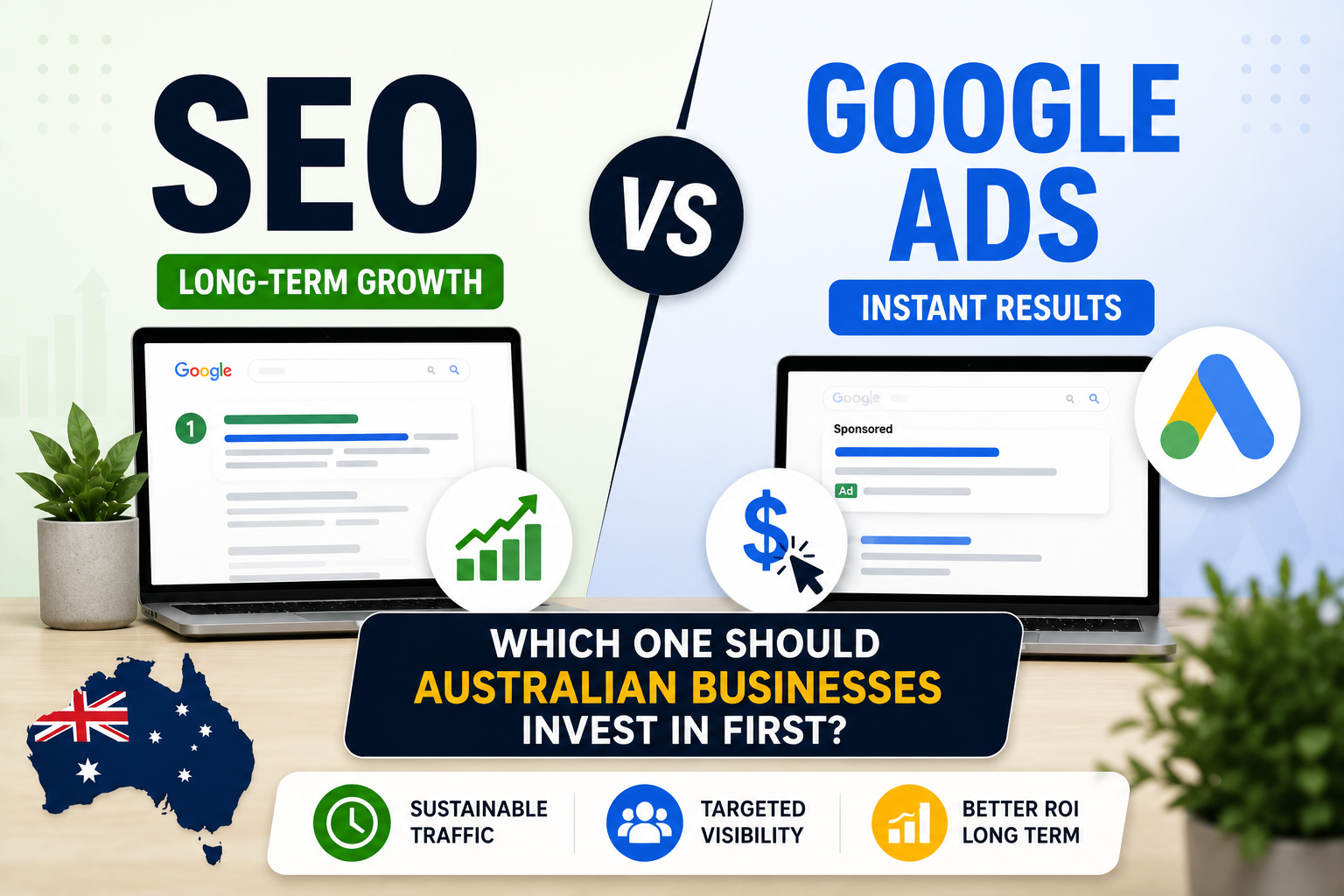
You have a marketing budget. You know you need to show up on Google. But which one actually deserves your money first, SEO or Google Ads?
This question comes up in almost every small business conversation across Australia, from a plumber in Perth to a boutique clothing brand in Melbourne. Both channels promise visibility. Both cost money and time. Yet they work in completely different ways, and picking the wrong one first can waste months of effort.
In this guide, we will break down what SEO and Google Ads actually do, how much they typically cost in Australia, how fast they deliver results, and which one makes sense depending on your business stage. No jargon, no hard sell, just a straight answer based on how these channels really perform.
What Is SEO and How Does It Work?
SEO stands for Search Engine Optimisation. It is the process of improving your website so it ranks higher in organic (unpaid) search results on Google.
When someone searches for something like “best cafe in Brisbane” or “emergency electrician Sydney,” Google shows a mix of paid ads and organic listings. SEO focuses purely on those organic listings, the ones without the small “Ad” label.
Good SEO involves several moving parts:
- Technical setup, so Google can crawl and understand your site
- On page content that answers what people are actually searching for
- Backlinks from other trusted websites
- Local signals, especially your Google Business Profile
- Site speed and mobile friendliness
SEO is often described as a long game. It usually takes three to six months before you see meaningful movement in rankings, and closer to six to twelve months for competitive industries. But once you rank, you do not pay per click. That traffic keeps coming in without an ongoing cost per visitor.
If you want a deeper look at how this process works, our SEO services page breaks down the exact steps we follow for Australian businesses.
What Is Google Ads and How Does It Work?
Google Ads is the paid side of search. You bid on keywords, and when someone searches those terms, your ad can appear at the top of the results page, marked with a small “Sponsored” tag.
Unlike SEO, Google Ads can deliver traffic within hours of launching a campaign. You set a budget, choose your target keywords and location, write your ad copy, and Google starts showing your ads almost immediately.
The catch is simple. You pay every time someone clicks, whether or not they buy anything. This is called cost per click, or CPC. In competitive Australian industries like legal services, finance, and home renovations, CPC can range anywhere from five dollars to over eighty dollars per click.
Google Ads gives you control that SEO cannot match. You can turn campaigns on or off instantly, test different offers, and target very specific suburbs or cities. This makes it a strong option for businesses that need leads right now, such as a new store opening or a seasonal promotion.
SEO vs Google Ads: A Side by Side Comparison
Here is how the two channels stack up across the factors that matter most to Australian business owners.
| Factor | SEO | Google Ads |
|---|---|---|
| Time to see results | 3 to 6 months, sometimes longer | Within hours to a few days |
| Ongoing cost | Lower long term, mainly time and effort | Ongoing cost per click, budget dependent |
| Traffic sustainability | Compounds over time, keeps working | Stops the moment you stop paying |
| Trust and credibility | Higher, organic results feel more trustworthy | Lower for some users who skip ads |
| Control and flexibility | Slower to adjust | Instant changes possible |
| Best for | Long term brand building, steady lead flow | Quick wins, launches, promotions |
| Upfront investment | Moderate, mostly labour and content | Can be low or high, fully scalable |
Neither option is better in every situation. It genuinely depends on your goals, timeline, and how much cash flow you have available right now.
Which One Should You Invest in First?
This is where most guides give a vague answer. Let us be direct instead.
Choose Google Ads First If
- You are a brand new business with zero online presence
- You need customers within the next few weeks, not months
- You are testing a new product or service and want fast market feedback
- You have a clear budget you can commit to for at least three months
- Your competitors already dominate organic search and you cannot wait to catch up
Google Ads works well here because it buys you visibility instantly. You are essentially renting the top of the page while you build something more permanent underneath.
Choose SEO First If
- You are building a long term brand and plan to operate for years
- Your budget is tight and you can invest more time than money
- You already have decent content or a website with some history
- You want to reduce dependence on paid advertising over time
- Your industry has strong local search intent, like tradies, clinics, or restaurants
SEO tends to reward patience. Once your rankings settle, that traffic becomes one of the cheapest, most sustainable sources of leads your business will have.
The Honest Middle Ground
Most successful Australian businesses eventually run both together. Google Ads brings in leads while SEO is still building momentum in the background. Once organic rankings improve, you can slowly reduce ad spend on certain keywords and redirect that budget elsewhere.
Think of Google Ads as the sprint and SEO as the marathon. Many businesses start the sprint to generate cash flow, then use some of that revenue to fund the marathon.
Real World Australian Context
Australian search behaviour has some unique traits worth noting.
According to Google’s own data, mobile searches with local intent, phrases like “near me” or a specific suburb name, have grown steadily across Australia over the past few years, particularly in service industries like plumbing, dentistry, and hospitality.
This matters because local SEO and Google Ads both rely heavily on location targeting. A Sydney based business competing only within its metro area faces different costs and competition than one targeting all of Australia.
Smaller cities and regional areas often see lower CPC in Google Ads and less SEO competition too, which means budget stretches further outside the major capital cities.
Cost Expectations for Australian Small Businesses
Pricing varies widely, but here is a realistic range based on common industry benchmarks in Australia.
SEO monthly investment:
- Small local business: 800 to 2,000 AUD per month
- Mid sized business: 2,000 to 5,000 AUD per month
- Competitive national industries: 5,000 AUD and above
Google Ads monthly ad spend (excluding management fees):
- Small local business: 500 to 2,000 AUD per month
- Mid sized business: 2,000 to 8,000 AUD per month
- Competitive industries like legal or finance: 10,000 AUD or more
These numbers are not fixed rules. They shift based on your industry, location, and competition level. A tailored strategy session usually gives a much clearer picture than any general estimate.
If you are still weighing your options, our team can walk you through both approaches based on your specific goals. Check out our Google Ads management services to see how a properly managed campaign is structured.
Common Mistakes Australian Businesses Make
- Expecting SEO results within a few weeks and giving up too early
- Running Google Ads without conversion tracking, so results are impossible to measure properly
- Ignoring mobile experience, even though most Australian searches now happen on phones
- Targeting broad match keywords without proper negative keyword lists, wasting ad budget
- Treating SEO and Google Ads as competitors instead of complementary tools
Avoiding these mistakes alone can significantly improve results, regardless of which channel you choose first.
Quick Decision Checklist
Ask yourself these questions before deciding:
- Do I need customers this month, or can I wait three to six months?
- Is my monthly budget better suited to a fixed ad spend or ongoing content work?
- Does my industry rely heavily on local search, like “near me” queries?
- Am I planning to run this business for years, or is this a short term venture?
- Can I dedicate time to content creation, or would I rather pay for instant traffic?
If most of your answers point toward speed and immediate need, start with Google Ads. If they point toward patience and long term growth, start with SEO.
Frequently Asked Questions
Is SEO better than Google Ads for small businesses in Australia?
Neither is universally better. SEO tends to suit businesses with time to invest and a long term outlook. Google Ads suits businesses needing quick, measurable results.
How long does SEO take to show results in Australia?
Most businesses start seeing meaningful ranking improvements within three to six months, though highly competitive industries can take longer.
Can I run SEO and Google Ads at the same time?
Yes, and many successful Australian businesses do exactly this. Ads bring short term traffic while SEO builds long term organic visibility.
What happens if I stop paying for Google Ads?
Your traffic and leads from that channel stop almost immediately, since Google Ads is a pay per click model with no lasting presence once spending stops.
Does SEO cost less than Google Ads over time?
Generally yes, once rankings are established, since you are not paying per click for that organic traffic. The upfront investment is mostly time and content rather than ongoing ad spend.
Final Thoughts
There is no single right answer for every business. A cafe opening next month in Adelaide has different needs than a law firm building its reputation over the next five years.
The smartest approach is matching the channel to your actual timeline and budget, not chasing whichever strategy sounds trendier. Start with what solves your most urgent problem, then build the other channel alongside it as your business grows.
If you are unsure where to begin, a quick conversation can save you months of guesswork. Get in touch with our team and we will help you figure out the right starting point for your specific business.