Picking a website platform feels bigger than it is.
You are not just choosing software. You are choosing how easily customers find you, how fast your site loads on the Gold Coast to Perth network, and how much you will spend fixing things later.
Every year, thousands of Australian business owners ask the same question. Should I build on WordPress? Should I use Shopify? Or is a custom website worth the extra spend?
There is no single right answer. But there is a right answer for your business, your budget and your goals.
This guide breaks down all three options in plain language. No jargon, no hard sell, just what actually matters for Australian businesses in 2026.
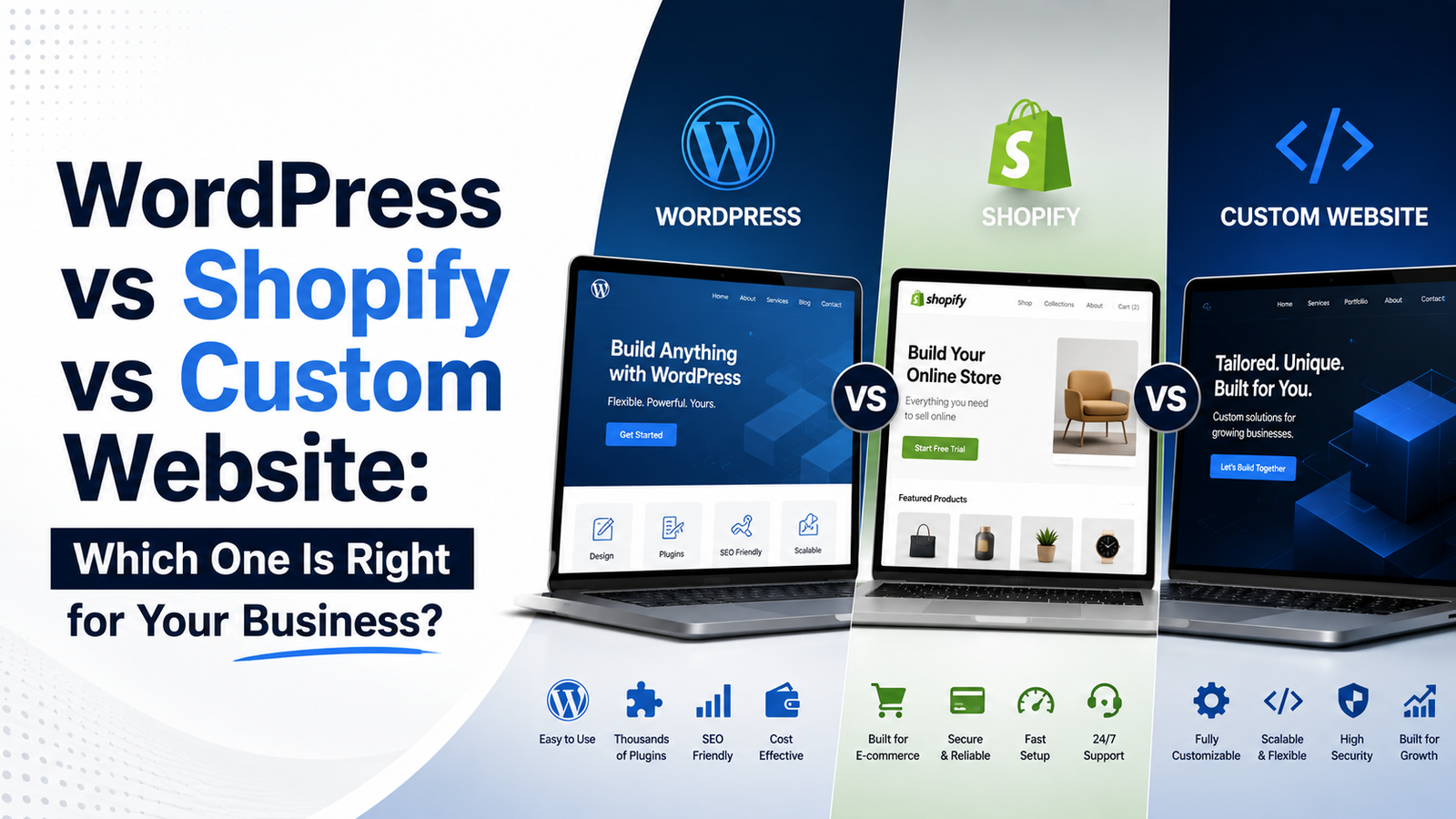
Quick Comparison: WordPress vs Shopify vs Custom Website
Here is the short version before we go deeper.
| Feature | WordPress | Shopify | Custom Website |
|---|---|---|---|
| Best for | Blogs, service businesses, content sites | Online stores, product sellers | Unique platforms, complex features |
| Starting cost (AUD) | $200 to $1,500 setup | $65 to $399 per month | $5,000 to $50,000+ |
| Ease of use | Moderate, needs some learning | Beginner friendly | Depends entirely on the build |
| SEO control | Excellent, very flexible | Good, some limitations | Full control, built from scratch |
| Ongoing maintenance | Regular updates needed | Handled by Shopify | Depends on your developer |
| Scalability | High with the right hosting | High for ecommerce specifically | Unlimited, built for your needs |
| Ownership | You own everything | Shopify hosts your store | You own everything |
Now let’s look at each option properly.
What Is WordPress and Who Is It Really For
WordPress powers a huge share of websites worldwide, and it remains popular across Australia for a simple reason. It is flexible.
WordPress started as a blogging tool. Today it runs everything from law firm websites to national news sites.
Why Australian Businesses Choose WordPress
- You control every part of the site, from design to functionality
- Thousands of free and paid plugins extend what your site can do
- It plays well with SEO, which matters if organic traffic drives your leads
- Content heavy sites like blogs, portfolios and service pages work brilliantly
Where WordPress Falls Short
WordPress needs upkeep. Plugins need updating. Themes need testing. Security needs attention, especially with hosting providers based outside Australia where support hours do not match your time zone.
If you want a set and forget system, WordPress will frustrate you. If you are comfortable learning the basics, or you have a developer on call, it rewards you with flexibility nothing else matches.
Good fit for: consultants, tradies, medical clinics, law firms, real estate agents, content publishers, and any business that relies on blog content or local SEO to attract customers.
What Is Shopify and Who Should Use It
Shopify is built for one purpose. Selling products online.
If you are running or planning an ecommerce store, Shopify removes most of the technical headache. Hosting, security, payment processing and mobile responsiveness are handled for you.
Why Shopify Works Well for Australian Ecommerce
- Setup takes days, not months
- Built in support for Australian payment gateways and Afterpay
- Handles GST calculations and invoicing requirements smoothly
- App marketplace covers almost every extra feature you might need
- Reliable uptime, which matters during sales events like Click Frenzy or Boxing Day
Where Shopify Has Limits
Shopify charges monthly fees plus transaction fees unless you use Shopify Payments. Highly custom designs or unusual business logic can hit a wall, since you are working inside Shopify’s structure rather than building freely.
Blog and content SEO on Shopify is decent but not as strong as WordPress for businesses that rely heavily on content marketing.
Good fit for: fashion brands, homeware sellers, beauty and skincare businesses, subscription box companies, and any business selling physical or digital products directly to consumers.
What Is a Custom Website and When Does It Make Sense
A custom website means building from the ground up. No template, no fixed system. Just your business requirements, coded specifically for you.
This is not the default choice for most small businesses, and it should not be. Custom builds cost more and take longer.
But for certain situations, nothing else works properly.
When a Custom Website Is Worth It
- You need a booking system, marketplace or membership platform that off the shelf tools cannot handle
- Your business involves complex calculations, integrations or user dashboards
- You are scaling fast and need a system that grows without hitting platform limits
- Your brand demands a completely unique user experience competitors cannot copy
The Real Cost of Custom Development
Custom websites in Australia typically range from $5,000 for a simple site to well over $50,000 for complex platforms with ongoing development. You are paying for developer time, testing and long term architecture, not a monthly subscription.
Good fit for: SaaS companies, marketplaces, businesses with unique booking or logistics needs, and larger companies wanting full ownership of their tech stack.
Cost Comparison Table for Australian Businesses
Budget usually decides this conversation before anything else does. Here is a realistic breakdown in Australian dollars.
| Cost type | WordPress | Shopify | Custom Website |
|---|---|---|---|
| Setup or build cost | $200 to $5,000 | $0 to $2,000 | $5,000 to $50,000+ |
| Monthly hosting | $15 to $100 | Included in plan | $30 to $300 |
| Monthly platform fee | None | $65 to $399 | None |
| Theme or design | $50 to $2,000 | $0 to $350 | Included in build |
| Maintenance per year | $500 to $3,000 | Minimal | $1,000 to $10,000+ |
| Transaction fees | Depends on gateway | 0 to 2 percent extra without Shopify Payments | Depends on gateway |
These figures shift depending on complexity, but they give you a realistic starting point for budgeting in 2026.
SEO and Search Visibility: How Each Platform Performs
Search visibility often decides whether a website actually brings in business. This is where a lot of owners get caught out.
WordPress generally offers the most SEO flexibility. You control URL structure, page speed optimisation, schema markup and content architecture down to the smallest detail.
Shopify has improved significantly, but some technical SEO elements remain fixed by the platform itself, such as certain URL structures for products and collections.
Custom websites offer full control, assuming your developer builds with SEO in mind from day one. That is a big assumption, so this needs to be part of the brief, not an afterthought.
Whichever platform you choose, the platform itself is only part of the story. Strategy, content and technical setup matter just as much as the software underneath. A proper SEO strategy tailored to your business often makes a bigger difference than the platform choice alone, especially for Australian businesses competing in local search results.
How to Decide: A Simple Framework
Rather than guessing, walk through these questions honestly.
- Are you selling physical products online? If yes, Shopify usually wins on speed to launch and reliability.
- Is content marketing or local SEO central to your growth? WordPress gives you more room to build authority through blog content and service pages.
- Do you need a system nothing off the shelf provides? A custom website is the only real option, despite the higher upfront cost.
- What is your monthly budget, realistically? Shopify suits predictable monthly costs. WordPress and custom builds front load the spend instead.
- Do you have ongoing technical support? Without it, WordPress and custom sites need a maintenance plan built into your budget from the start.
Real World Scenario: An Australian Retail Business
Picture a small homeware brand based in Melbourne, selling ceramics and candles online plus at weekend markets.
They started on a free website builder, struggled with slow checkout speeds during a sale, and lost orders during peak traffic. Moving to Shopify solved the checkout and inventory problem within weeks, with built in support for local payment methods customers already trusted.
Compare that to a Sydney based financial advisory firm. Their growth came from blog content and local search rankings, not online sales. WordPress suited them far better, since their whole strategy relied on content and search visibility rather than ecommerce checkout speed.
Same country, same year, completely different platform decisions. That is the point. Your business model decides the answer, not trends.
Tips for Choosing the Right Platform
- Do not choose based on what a competitor uses. Their goals may differ completely from yours.
- Factor in maintenance time, not just setup cost, when comparing options.
- Test load speed on mobile data, since a large share of Australian shoppers browse on phones, not desktops.
- Ask any developer or agency for examples of similar businesses they have built for.
- Plan for growth. Migrating platforms later costs more than choosing carefully upfront.
Common Mistakes Australian Businesses Make
- Choosing Shopify for a content heavy business, then struggling with blog SEO later
- Building on WordPress without a maintenance plan, then facing security issues
- Commissioning a custom build for a simple product catalogue that Shopify would have handled cheaper and faster
- Ignoring mobile speed and checkout testing before launch
- Underestimating ongoing costs, then abandoning the site within a year
Frequently Asked Questions
Is WordPress or Shopify better for SEO in Australia?
WordPress generally offers more SEO flexibility, particularly for content marketing and local search. Shopify has strong built in SEO basics but fewer customisation options for advanced technical SEO.
How much does a custom website cost in Australia?
Most custom websites in Australia start around $5,000 for straightforward builds and can exceed $50,000 for complex platforms with ongoing features and integrations.
Can I switch from Shopify to WordPress later, or the other way around?
Yes, but migration takes planning. Product data, URLs and SEO rankings need careful handling to avoid losing search visibility during the switch.
Is Shopify worth the monthly fee compared to a one time WordPress setup?
For most ecommerce businesses, yes. The monthly fee covers hosting, security and support that would otherwise cost more to manage separately on WordPress.
Do I need a developer to run a WordPress website?
Not always. Many business owners manage basic WordPress sites themselves. A developer becomes valuable for custom features, security hardening and troubleshooting.
Which platform is best for a small local business in Australia?
For service based businesses relying on local search, WordPress usually performs well. For product based businesses, Shopify is typically the faster and simpler choice.
Final Thoughts
There is no universal winner between WordPress, Shopify and custom websites. Each one solves a different problem well.
WordPress rewards businesses that need flexibility and content driven growth. Shopify rewards businesses that need a fast, reliable store without technical overhead. Custom websites reward businesses with needs no template can satisfy.
Choose based on your business model, your budget and how much technical involvement you actually want, not on what sounds trendy this year.
Once your platform is sorted, the next question is usually how to get found once the site is live. Paid visibility through Google Ads campaigns built for Australian audiencescan bring in customers immediately while organic search builds over time.
If you are still unsure which direction fits your business, it helps to talk it through with someone who has seen these decisions play out across different industries. Get in touch with our team and we will walk you through what makes sense for your specific goals and budget.